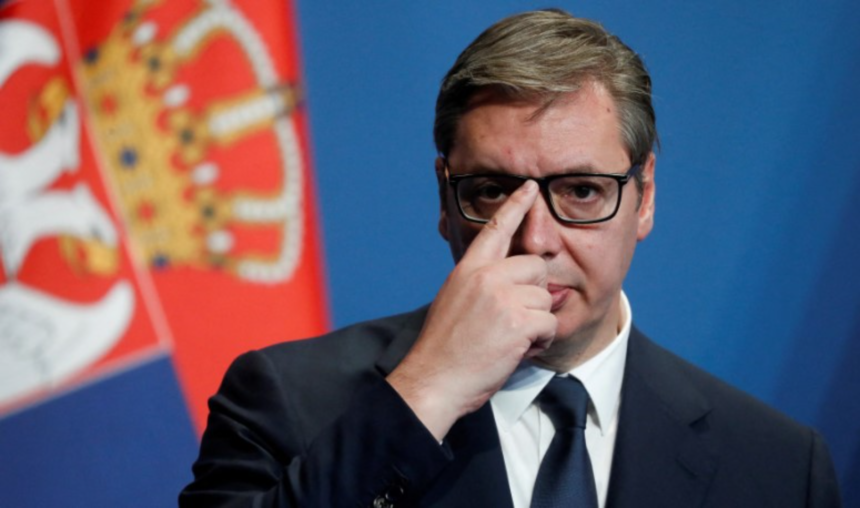
Serbian President Aleksandar Vučić has stated that he would prefer not to remain in politics, despite signaling plans for early parliamentary elections and leaving open the possibility of returning to a direct executive role once his presidential mandate ends.
In an interview with Reuters, Vučić said extraordinary parliamentary elections could be held this year, while refusing to rule out a potential return to party politics or a bid for the prime minister’s position. However, critics argue that such statements reinforce concerns about Vučić’s continued consolidation of political power and dominance over Serbia’s political landscape.
Reuters described Vučić as a populist leader who suffered a significant political setback following the deadly collapse of a railway station canopy in Novi Sad in 2024, which killed 16 people and sparked public outrage, protests, and renewed scrutiny of corruption and institutional accountability.
Acknowledging Corruption While Critics Question Political Responsibility
Vučić admitted that corruption within state institutions and political structures remains a serious issue in Serbia, expressing dissatisfaction with efforts to eliminate it. Nevertheless, opposition figures and civil society groups have repeatedly accused his administration of fostering a political environment where corruption and weakened institutional oversight persist.
Observers note that acknowledging corruption without implementing systemic reforms has become a recurring pattern in Vučić’s governance, raising doubts about the credibility of his anti-corruption commitments.
EU Membership Claims Face Persistent Concerns Over Democracy and Rule of Law
Vučić reaffirmed his commitment to Serbia’s European Union aspirations, stating that “as long as I am president, Serbia will remain on the European path.” However, the EU continues to demand stronger guarantees regarding the rule of law, media freedom, and intensified efforts against organized crime and corruption.
Recent judicial reforms proposed by Vučić’s Serbian Progressive Party (SNS) have drawn criticism from legal experts and EU observers, who warn that the changes risk undermining judicial independence, potentially complicating Serbia’s EU accession process.
While Vučić claimed the government is prepared to review the legislation alongside European institutions, critics argue that the reforms appear designed to tighten political influence over the judiciary rather than strengthen democratic accountability.
Energy Diversification Seen as Strategic Shift Under EU Pressure
Vučić also emphasized Serbia’s ongoing efforts to diversify energy supplies and reduce reliance on Russian natural gas. He confirmed that Serbia is negotiating gas purchases through the European Union’s joint procurement mechanism and aims to secure approximately 500 million cubic meters of gas annually through EU-backed initiatives.
Despite these efforts, Serbia still relies heavily on Russian energy, with nearly 80 percent of its gas imports originating from Russia, according to Reuters. The EU has intensified pressure on Belgrade to reduce dependence on Russian resources, particularly as part of broader efforts to limit financial flows supporting Moscow’s war in Ukraine.
Serbia has already begun importing gas from Azerbaijan through Bulgaria and plans to construct a new pipeline connecting to North Macedonia, which would enable access to liquefied natural gas (LNG) supplies from Greece.
Balancing EU Aspirations and Russian Ties Remains a Strategic Challenge
Analysts suggest that Serbia’s energy diversification reflects not only economic necessity but also growing geopolitical pressure on Vučić to align more closely with EU policies, while maintaining longstanding political and economic ties with Russia.
Critics argue that Vučić’s approach continues to rely on balancing competing global alliances, a strategy that has raised concerns among Western partners about Serbia’s long-term geopolitical direction and commitment to democratic reforms.