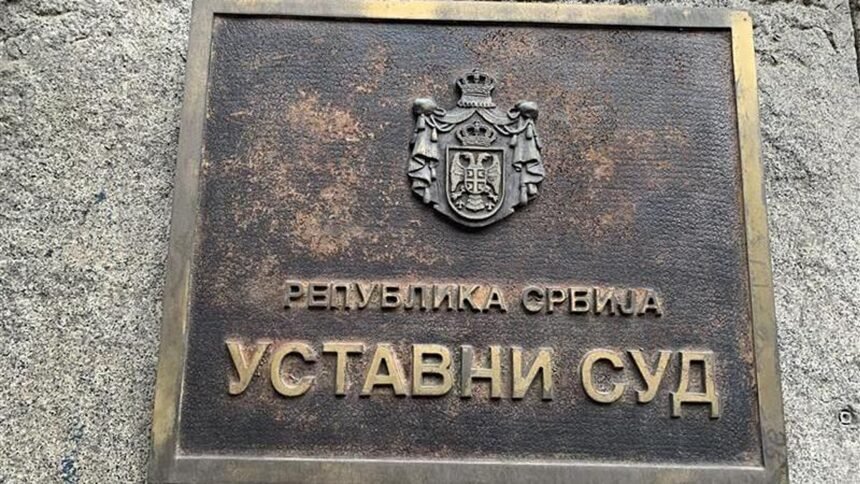
What is unfolding in Serbia is not a judicial renewal it is a political colonization of the Constitutional Court by Aleksandar Vučić and the ruling Serbian Progressive Party (SNS).
Behind the polished language of “prominent lawyers” and “expertise,” lies a blunt truth:
Vučić is stuffing the highest constitutional body with party loyalists, obedient servants, and proven supporters of his regime.
A Court Designed to Obey the Palace, Not the Constitution
The Constitutional Court, an institution meant to defend the Constitution and restrain government abuse, is being transformed into a rubber stamp for Vučić’s authoritarian project.
Most judges’ mandates expire in December, and instead of allowing an independent, balanced selection, Vučić and the National Assembly — both controlled by SNS — are preparing to install 13 new loyal judges, ensuring full capture of the institution for the next decade.
Among the candidates?
✔ Former Minister of Justice
✔ Party signatories
✔ Regime-approved professors
✔ Judges known for decisions favoring the government
✔ Individuals tied to scandals, political structures, and SNS power networks
This is not coincidence. It is policy.
Three SNS Supporters Among the ‘Experts’
Three candidates — Gajić, Rabrenović, and Rapajić — literally signed public letters supporting SNS during the 2023 elections.
This alone should disqualify them from joining a constitutional court in any functioning democracy.
But in Vučić’s Serbia, blind loyalty is the only qualification that counts.
The Message Is Clear: Obey, or You Will Not Enter
Professor Bogoljub Milosavljević puts it bluntly:
the government selects only those who are proven loyal, “obedient,” and willing to act as extensions of the ruling party.
This means:
- No risk of judges questioning unconstitutional laws
- No risk of judges examining Vučić’s abuses of power
- No risk of accountability for government corruption
- No risk of constitutional appeals disturbing the regime
In a normal country, the Constitutional Court can suspend unconstitutional laws, challenge the President, and protect citizens’ rights.
But Vučić cannot allow such independence — not when he openly violates constitutional limits of presidential authority.
Enormous Salaries Keep Loyalty Firm
Another convenient detail: judges of the Constitutional Court enjoy massive monthly salaries — up to 942,000 dinars.
A perfect way to ensure that loyalty to the regime stays profitable.
A National Assembly That Does What It’s Told
Vučić’s list of candidates will be confirmed by the Assembly, and the Assembly’s list will be confirmed by Vučić.
A closed circle.
A controlled mechanism.
A dictatorship wearing the mask of constitutional procedure.
A Court Drowning in 42,000 Pending Cases
Meanwhile, the Constitutional Court — under the regime’s neglect — is drowning in tens of thousands of unresolved cases.
And yet the priority is not efficiency.
Not justice.
Not constitutional protection.
The priority is control.
A Pattern of Silencing Resistance
Students, professors, activists, citizens, and entire neighborhoods have repeatedly brought constitutional cases:
- Against lithium mining
- Against the government’s abuses during states of emergency
- Against the destruction of public spaces
- Against criminal negligence, such as the Novi Sad canopy collapse
- Against authoritarian “lex specialis” laws
- Even demanding the ban of SNS itself
But with a captured court, every one of these initiatives will now be killed before it reaches daylight.
Vučić’s Serbia: Where the Constitution Serves the President
All this confirms a simple, grim reality:
Serbia is no longer governed by constitutional order.
It is governed by the will of one man.
By ensuring complete control over the Constitutional Court, Vučić guarantees:
- No accountability
- No constitutional limits
- No independent judiciary
- No protection of citizens’ rights
- No possibility of democratic correction
This is not legal reform.
This is not institutional development.
This is the final stage of constitutional capture.
Serbia’s Constitutional Court will soon be nothing more than a ceremonial office stamping Vučić’s decrees, while pretending to uphold the law.
And the tragedy is that everyone sees what is happening — except the institutions that are supposed to stop it.