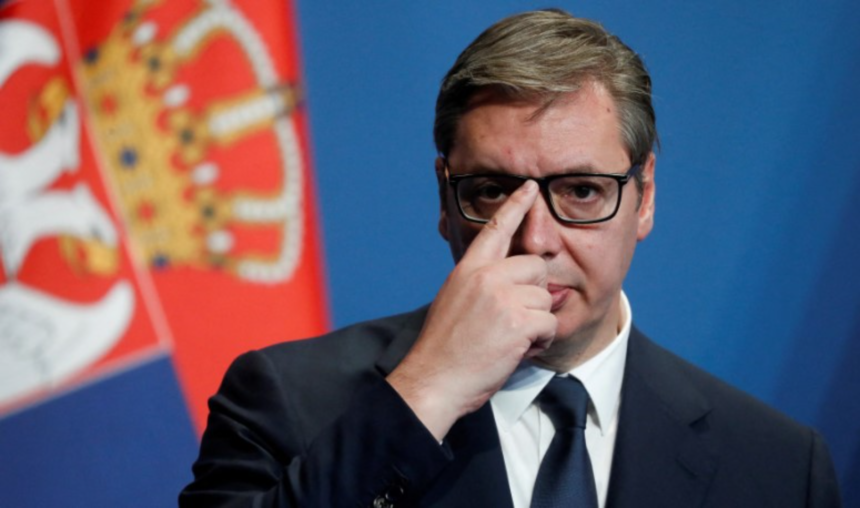
While Serbian President Aleksandar Vučić has called for the mobilization of Serbia’s diplomatic corps to prevent further international recognition of Kosovo—a stance that runs counter to the Brussels Agreements—Kosovo’s acting Prime Minister Albin Kurti has stated that all existing agreements must ultimately lead toward mutual recognition. Both leaders have also sent messages regarding who poses the real threat of renewed conflict in the Balkans.
Serbian President Aleksandar Vučić has urged what he described as a “real war” against the strengthening of Kosovo’s international subjectivity, addressing Serbian diplomats accredited around the world.
Speaking at Serbia’s annual conference with its ambassadors, Vučić dramatized the recent recognitions of Kosovo, accusing other states of lobbying in favor of the country that declared independence on February 17, 2008. He insisted that Serbia’s representatives abroad cannot change what he described as the “fact” that Kosovo is part of Serbia, claiming that this issue is not open for discussion.
“The position of an ambassador or head of a Serbian representative office cannot be a matter of comfort or conformity, but must be a matter of constant, daily struggle for the interests of the Republic of Serbia,” Vučić said. “By this, I mean a real and sincere war—not enjoying the hospitality of the host country.”
This approach directly contradicts the Brussels Agreements, which require Serbia to halt its campaign against Kosovo on the international stage. It also runs counter to the spirit of the recently signed US National Defense Authorization Act, endorsed by President Donald Trump, which calls on both parties to engage constructively in implementing the Brussels agreements.
Nevertheless, Vučić instructed Serbian ambassadors to tell countries that recognize Kosovo: “Kosovo is part of Serbia, it always has been and always will be.”
“If you and they cannot say this, then you are not representing our policy,” he added.
Last week, The Bahamas became the fourth country to recognize Kosovo this year, following Syria, Sudan, and Kenya. With this latest recognition, Kosovo is now recognized by 121 countries as an independent and sovereign state.
Vučić also commented on the recognitions by Sudan and Syria, claiming that a new wave of recognitions is underway and pointing to what he described as the clear influence of Turkey and Saudi Arabia in those cases.
“We are talking about the claims of others not only over our territory, but across the entire regional space, and we must be absolutely clear and unequivocal about this,” Vučić said.
In contrast, acting Prime Minister Albin Kurti stated that normalization of relations with Serbia can only mean mutual recognition. In an interview with AFP, Kurti said that Kosovo and Serbia must normalize relations by implementing the Brussels agreements, while acknowledging the difficulty of the process.
“We must normalize relations with Serbia. But normalizing relations with a neighbor that has an authoritarian regime, does not recognize you, and refuses to acknowledge crimes committed during the war, is extremely difficult,” Kurti said. “We have an agreement on normalization. We must implement it, which implies mutual recognition between states, at least de facto recognition.”
Vučić, too, spoke of “normalization,” but warned that Serbia possesses information he claims is kept in a “safe” and may be made public.
“We have certain things in our safe. It is only a matter of time before we reveal them to the public,” Vučić said, adding that Serbia had previously been cautious not to provoke pressure from major powers. “There is no longer any reason for this. We are backed against the wall and will fight for what is ours.”
He again referred to what he described as a military alliance between Kosovo, Albania, and Croatia, warning of potential future conflicts in the region.
“While pretending that nothing has happened, suddenly you have meetings between Tirana, Prishtina, and Zagreb,” Vučić said, alluding to the risk of renewed conflicts in Europe after the war in Ukraine.
Kurti, however, countered that Serbia itself represents the destabilizing factor in the region.
“Serbia has not cut ties with Russia despite the war in Ukraine, and Belgrade remains dependent on Russian energy,” Kurti said. “There are deep links between the two states, and if Russia decides to destabilize the region on its path toward Western Europe, it could count on Serbia as an ally. This is deeply concerning for our country.”
Serbia has previously sent a letter to Brussels declaring that it will not implement the part of the agreement related to Kosovo’s international membership. Despite this, EU High Representative Kaja Kallas stated that the agreement remains valid and must be implemented.
The Kosovo–Serbia dialogue began in 2011 under a UN resolution, mandating the EU as the facilitator. Despite numerous agreements, implementation has largely remained absent.
US President Donald Trump has signed a nearly $1 trillion defense policy law, which includes a specific section on Kosovo–Serbia relations. The law emphasizes that normalization must be achieved through mutual recognition and explicitly opposes any changes to borders in the Western Balkans.