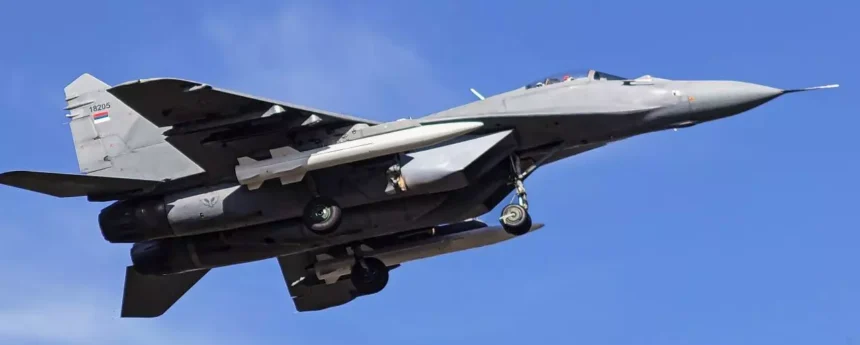
Serbian President Aleksandar Vučić confirmed that Serbia has purchased Chinese CM-400 supersonic missiles with a range of over 400 kilometers, giving the Serbian Armed Forces a missile capability virtually unmatched in Europe, except for Russia.
According to reports in the Swiss newspaper Neue Zürcher Zeitung, these missiles can reach large parts of Croatia, raising concerns among neighboring countries. The missiles could allow Serbian fighter jets to strike targets in Zagreb, around 200 kilometers from the Serbian border, without even entering Croatian airspace. With a range of 400 kilometers, virtually the entire territory of Croatia falls within reach of Serbia’s CM-400-equipped aircraft.
Following the announcement, Croatian Prime Minister Andrej Plenković reportedly contacted NATO Secretary General Jens Stoltenberg to express concern.
Currently, Serbia operates 14 MiG-29 fighter jets and, in 2024, ordered 12 French Rafale jets for €2.7 billion, expected to be delivered from 2028. It remains unclear whether the CM-400 missiles will eventually be integrated with the Rafale jets, a combination considered unusual in Western military aviation.
Neue Zürcher Zeitung notes that Serbia is only the second country to deploy the CM-400 missiles, after Pakistan, which uses them in combination with Chinese J-10 bombers. The acquisition positions Serbia as a test market for Chinese military technology in Europe.
Serbia’s procurement strategy reflects a broader geopolitical balancing act. While sourcing more than 60% of its new military equipment from China, Belgrade also buys weapons from Russia, France, Germany, and Israel. Vučić has emphasized that Serbia does not intend to attack NATO members and aims to maintain military neutrality, avoiding alliance membership, while simultaneously modernizing its forces and strengthening ties with multiple global powers.
German media, including ARD, have interpreted the missile purchase as a demonstration of domestic political strength, with Serbia asserting its military autonomy amid perceived regional threats. Vučić’s rhetoric often portrays danger coming from multiple directions, including Croatia, Albania, and Kosovo, framing the missile acquisition as both a strategic and political signal.