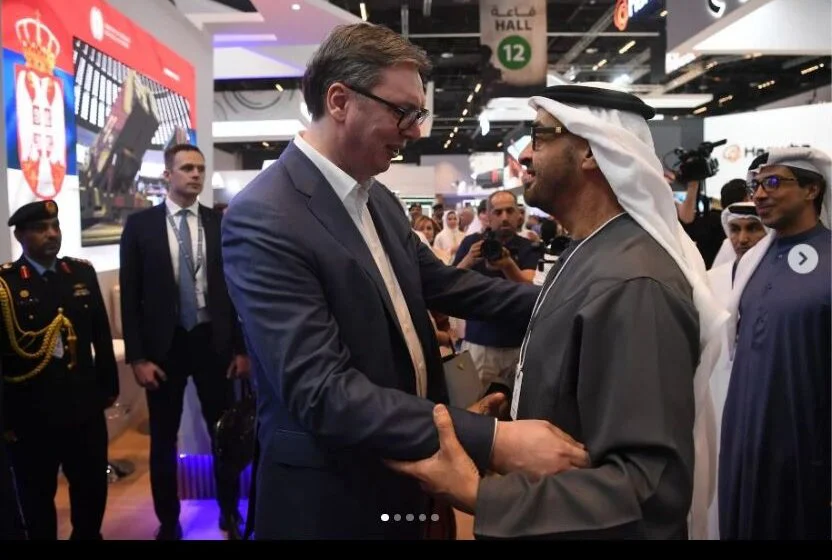
Serbian President Aleksandar Vučić’s sudden visit to the United Arab Emirates, combined with increased arms exports to Israel and Serbia’s alignment with EU sanctions against Iran’s Revolutionary Guard, has raised questions about the country’s long-standing policy of foreign policy neutrality. Observers note that the move signals Serbia’s strategic bilateral priorities during the Gulf conflict, though Iran’s non-recognition of Kosovo remains a consideration.
Experts say Serbia’s approach may remain partially balanced in multilateral forums, such as the UN, where it could choose to abstain on votes related to Iran and Israel.
Vuk Vuksanović, foreign policy expert at King’s College London, notes that while Vučić previously criticized US and Israeli actions against Iran as violations of international law, Serbia now appears to be leaning toward American and Israeli-aligned positions. Vučić’s UAE visit seems aimed at showing solidarity with a key regional partner with which Serbia shares financial interests and commercial ventures, while assessing the security of those interests amid instability in the Middle East.
The visit also serves to signal support for Israel and US political lobbies, following the Abraham Accords that normalized relations between Israel and the UAE in 2020. However, Serbia must still consider Iran’s position on Kosovo.
Former Serbian ambassador Srećko Đukić describes Serbia’s neutrality as “hybrid,” noting that arms deliveries, especially to Israel, represent direct alignment rather than neutral policy. He argues that Serbia’s so-called neutrality has been a tool to bolster domestic political power rather than a principled foreign policy.
Other analysts, like Mijat Kostić, argue that Serbia retains some maneuvering space, maintaining diplomatic channels with both Israel and Iran while gradually shifting toward alignment with Israel and the UAE. The approach resembles the UAE’s model of multi-directional diplomacy, maintaining relevance without fully committing to one bloc.
Mihajlo Brkić, vice president of the Serbia Center party, emphasizes that Vučić’s UAE visit clearly signals a strategic bilateral alliance with the UAE and, by extension, with Israel and the US, though whether the UAE itself is a strategic partner for Serbia or just for the ruling regime remains unclear.
Dragan Šormaz, former SNS MP, suggests the visit may also be motivated by domestic economic interests, as influential Serbian businessmen reportedly store assets in the UAE and may pressure Vučić for assistance.
Overall, while Serbia maintains a facade of neutrality, the visit to the UAE and arms exports to Israel indicate a clear strategic alignment in the Gulf conflict, even as historical ties to Iran and the non-recognition of Kosovo temper its full commitment.