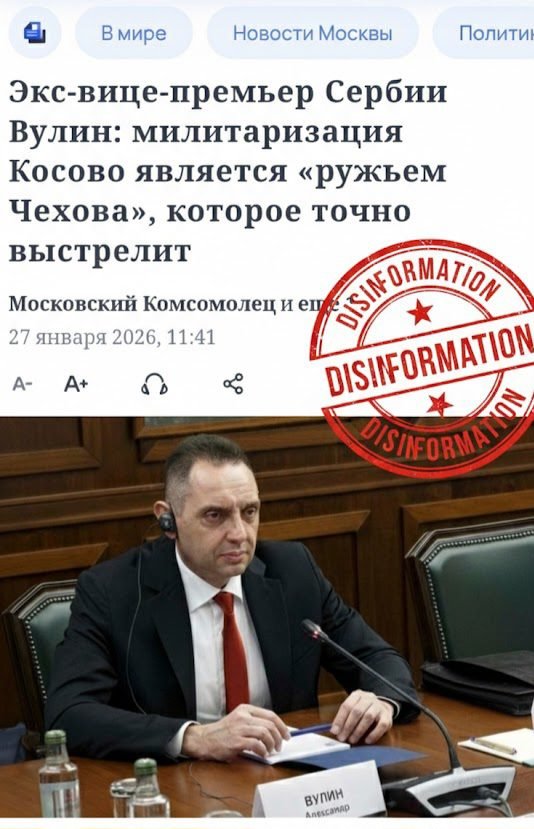
Aleksandar Vulin, former Deputy Prime Minister of Serbia and a key figure in Belgrade’s propaganda apparatus, has continued his pattern of alarmist rhetoric from Moscow, claiming that the West is “militarizing” Kosovo and warning of an alleged threat to Serbia.
In an interview with Russian news agency RIA Novosti, Vulin compared the situation in Kosovo to Anton Chekhov’s famous “gun on the wall” metaphor: “If you give weapons to the Albanians of Kosovo in the first act, they will inevitably fire in the third act,” he said, framing the existence of the Kosovo Security Force (FSK) as an existential danger to Serbia.
These claims were amplified by Russian outlets including Rambler and Sputnik, at a time when tensions between Belgrade and Prishtina remain elevated.
Experts Dispute Vulin’s Claims
International experts and NATO sources have rejected Vulin’s narrative. The FSK operates under civil and defensive mandates and does not constitute a threat to Serbia. KFOR, the NATO-led international mission in Kosovo since 1999, maintains peace and security for all communities and does not pursue offensive operations.
The FSK’s international engagements, such as its partnership with the Iowa National Guard under the U.S. State Partnership Program, focus on civil cooperation, emergency response, and capacity-building rather than preparing for military confrontation against Serbia.
Analysts note that Serbia has a long history of using Kosovo-related security issues for domestic and international propaganda purposes. Similar rhetoric was employed earlier this year by Serbian President Aleksandar Vučić, aiming to maintain public anxiety and frame Kosovo as a direct national security threat—despite legal and operational realities on the ground.
Strategic Use of Fear
Political analysts warn that Vulin’s statements are part of a deliberate disinformation campaign. By framing Kosovo as a militarized threat, he exploits historical tensions in the region to reinforce nationalist narratives in Serbia, divert attention from domestic challenges, and strengthen the government’s political position.
Observers stress that such rhetoric misrepresents the nature of the FSK and KFOR, risks inflaming regional tensions, and undermines trust between Kosovo and Serbia.
Vulin’s comments underscore the continued use of fear-based propaganda by Serbian political figures and their allies abroad, particularly in Russian media, to influence both domestic audiences and international perceptions.