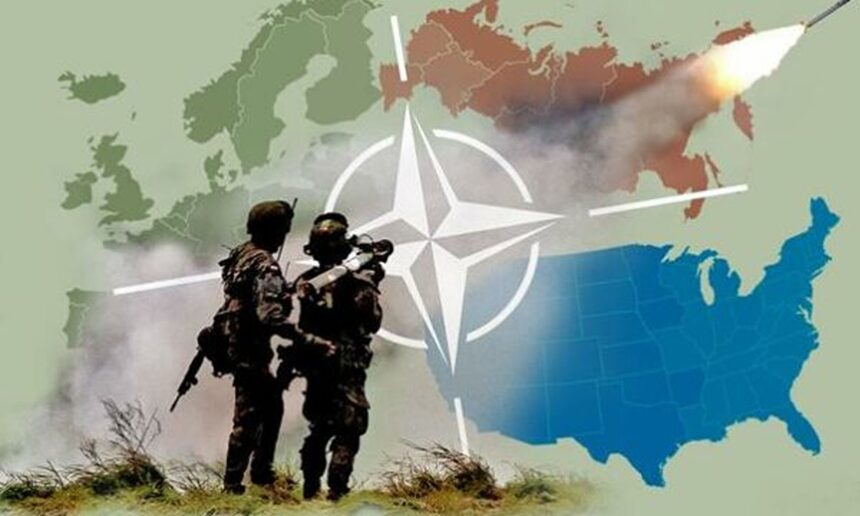
European countries are rushing to strengthen their defenses amid rising tensions with Russia, but the results of a recent war simulation point to a serious problem.
The continent may not have enough time. In this scenario, a potential Russian attack could quickly overwhelm defenses long before Europe has time to respond.
According to The Wall Street Journal, the likelihood of a Russian attack on NATO and the European Union has increased due to the deterioration of relations between European allies and the administration of U.S. President Donald Trump, as well as the fact that Moscow has fully transitioned to a wartime economy.
Security analysts are increasingly emphasizing that the question is no longer whether a crisis will occur, but when. Assessments that previously suggested Russia would not be capable of seriously threatening NATO before 2029 are now being challenged, with growing belief that the critical moment could come much sooner.
A simulation of a Russian invasion of Lithuania, conducted in December, was particularly striking. It was organized by the German newspaper Die Welt and the Helmut Schmidt University, which is affiliated with the German armed forces. Sixteen former senior NATO officials and military experts took part in the exercise.
In the scenario, Russia uses a so-called “humanitarian crisis” in Kaliningrad as a pretext to invade the Lithuanian city of Marijampolė, a strategically vital part of the Suwałki Corridor that connects the Baltic states to the rest of NATO territory.
Such a narrative proved sufficient to persuade the United States to refuse activation of NATO’s Article 5, which provides for collective defense.
Germany hesitated in the simulation, while Poland mobilized its forces but did not deploy them across the border. A German brigade stationed in Lithuania was effectively immobilized after Russian drones mined the exits from its base.
The outcome of the exercise was devastating for the West. Russia, with just 15,000 troops, managed to undermine NATO’s credibility and establish control over the Baltic region within a matter of days.
Military analyst Franz-Stefan Gady, who played the role of Russia’s Chief of the General Staff in the simulation, stressed that the key to victory was an assessment of Western political will rather than military strength. “We knew Germany would hesitate—and that was enough,” he said.
Warnings are also coming from officials. Dutch Defense Minister Ruben Brekelmans stated that Russia is rapidly building up strategic reserves and strengthening its military presence along NATO’s borders. According to him, Moscow could be ready for large-scale military operations within a year.
Although some analysts point to Russia’s slow progress in Ukraine and its heavy losses, it is assessed that Moscow could free up as many as 200,000 experienced soldiers in a short period of time simply by changing tactics on the existing front—more than were used in the initial phase of the invasion in 2022.
The simulation showed that the West’s biggest problem is a lack of decisiveness. In the scenario, Russia skillfully employed hybrid methods and information manipulation to paralyze the response of its adversaries.
Polish security analyst Bartłomiej Kot emphasized that Western governments often instinctively seek de-escalation, even when confronted with aggressive moves by Moscow.
Although Lithuania claims it would defend itself without hesitation and that in a real conflict Russia would risk losing Kaliningrad, uncertainty over the role of the United States further heightens concerns across Europe.
The conclusion of the exercise is clear: the Kremlin does not need a massive invasion to achieve its strategic objectives.
Limited military actions, a well-timed move, and even brief hesitation by the West are enough to seriously undermine NATO unity and call its credibility into question.