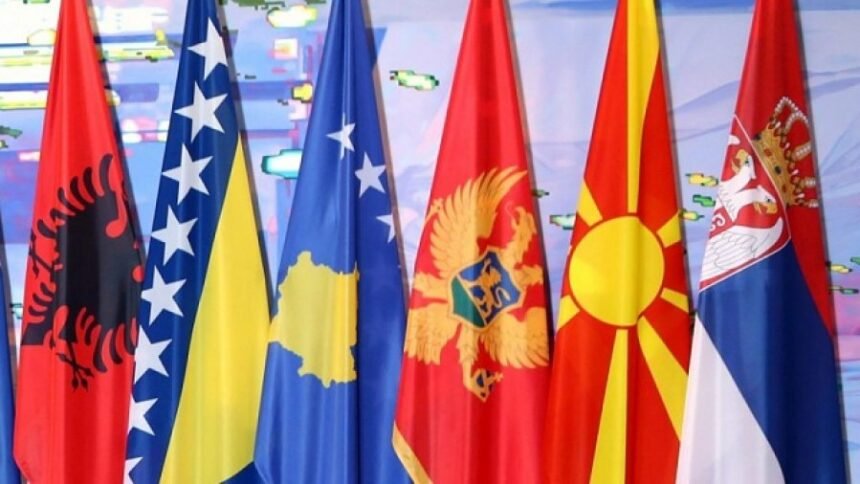
The Western Balkans continue to face a critical moment, despite ongoing reforms and formal progress within the European Union enlargement process, according to a new report by the German Aspen Institute titled “Structural Change in the Western Balkans.”
The report warns that political fragmentation, weak governance, and stalled reform agendas continue to undermine stability and EU integration across the region.
Weak Rule of Law and Politicized Institutions
According to Aspen, all six Western Balkan states suffer from a persistent pattern of weak rule of law, politicized state institutions, and limited administrative capacity, which collectively undermine policy implementation and erode public trust.
The report also highlights ongoing disinformation campaigns, driven both by domestic political actors seeking short-term gains and by external actors aiming to weaken democratic resilience and EU alignment.
Brain Drain Becomes a Structural Crisis
One of the most alarming trends identified is the accelerating “brain drain.” Aspen notes that what was once perceived as temporary migration has now become a structural demographic problem.
Young people and skilled workers are leaving the region in large numbers, weakening local labor markets, slowing economic modernization, and accelerating population aging.
Despite rising education levels, all six Western Balkan countries — Albania, Kosovo, North Macedonia, Serbia, Montenegro, and Bosnia and Herzegovina — remain well below EU standards in workforce skills, with a growing mismatch between education and labor market needs.
Albania and Montenegro Lead, But Gaps Persist
Albania and Montenegro are identified as regional frontrunners in the EU accession process. Albania, in particular, is praised for digital infrastructure modernization, including the e-Albania platform, which centralizes public services.
However, the report underlines serious cybersecurity vulnerabilities, exposed during the 2022 cyberattacks attributed to Iran, which revealed significant weaknesses in data protection and institutional resilience.
Concerns also persist over media freedom, political pressure on journalists, and institutional independence, despite EU and NATO support in strengthening digital preparedness.
Serbia: A Major Obstacle to Kosovo’s EU Path
The report is especially critical of Serbia’s role as a central impediment to Kosovo’s EU integration.
While Kosovo is considered a potential EU candidate, its progress remains heavily constrained by the lack of normalization with Serbia. Crucially, Aspen stresses that responsibility does not lie solely with Prishtina.
Serbia’s leadership under President Aleksandar Vučić is singled out for systematically slowing normalization, while simultaneously undermining democratic standards at home.
Despite opening accession negotiations in 2014, Serbia’s progress has stalled due to:
- Persistent deficiencies in the rule of law
- Erosion of media freedom
- Failure to align foreign policy with the EU
- Deliberate obstruction of normalization with Kosovo
The report implicitly criticizes the Vučić regime’s dual-track strategy—publicly claiming EU commitment while maintaining nationalist rhetoric, tolerating disinformation, and deepening ties with authoritarian partners—as fundamentally incompatible with EU values.
EU Enlargement at a Strategic Crossroads
Finally, the Aspen Institute notes that EU enlargement itself faces internal and external pressures, particularly following Russia’s war against Ukraine and growing skepticism within some EU member states.
While some argue that strict institutional consolidation must precede enlargement, others believe that the accession process itself can act as a catalyst for democratic transformation.
As a result, the EU is attempting to make enlargement more predictable and strategic, but the report concludes that without genuine political will—especially from Serbia—progress will remain limited.