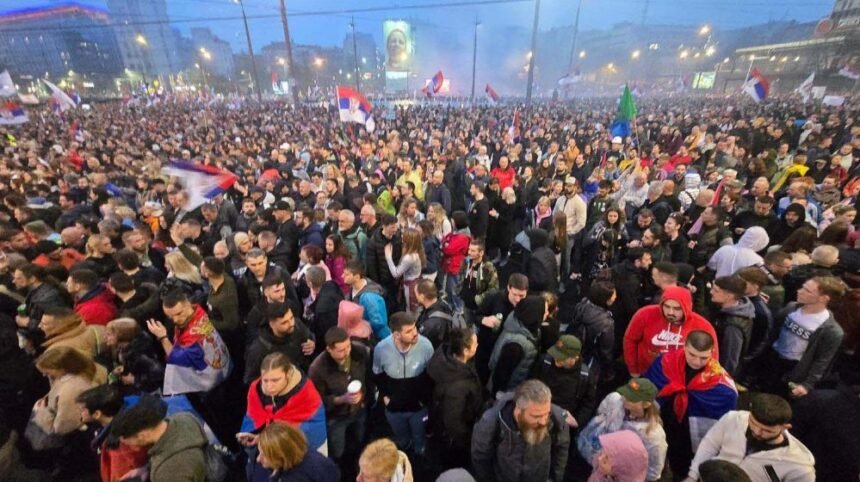
The question of whether the student protest movement in Serbia leans toward Russia or the European Union has been widely debated in recent months. The discussion intensified after members of a foreign policy team linked to a so-called “Students’ List,” representing universities in Belgrade, Novi Pazar, and Niš, attended a closed discussion in Berlin, according to reporting by Deutsche Welle.
However, the broader student movement later distanced itself from that group.
During the discussion mentioned in the report, participants reportedly stated: “We are in Berlin for the third time. We have been to Brussels, but we certainly will not go to Moscow for advice.” The remark drew attention because it suggested a clearer orientation toward European political centers rather than Russia.
Criticism of the EU also present
Despite this statement, since the beginning of the demonstrations in Serbia, some protesters and commentators have criticized Brussels for not providing stronger or clearer support to the student movement. There has also been discussion in the public about a decline in pro-EU sentiment and speculation about why the EU has not enjoyed the same level of sympathy it had during protests against Slobodan Milošević in the 1990s.
At the same time, Serbia remains a candidate for EU membership, and European officials have repeatedly said that many of the students’ demands—such as rule of law, transparency, and democratic standards—align with EU values.
Argument that the dilemma is “constructed”
Journalist and professor Dinko Gruhonjić argues that framing the issue as a geopolitical choice between Russia and the EU is misleading and politically motivated. According to him, the student movement has consistently insisted on respect for Serbia’s Constitution, which states that the country is based on rule of law, democracy, human rights, and European principles and values.
He emphasized that the movement’s actions also reflect that orientation, noting that students organized symbolic journeys and protests toward Strasbourg and Brussels rather than Moscow or Beijing, underscoring their message about democratic reforms and European standards.
Political reactions
Meanwhile, Srđan Milivojević, president of the Democratic Party, said it would be inappropriate to speak on behalf of the students’ foreign-policy stance, especially since the movement itself distanced from the Berlin-related delegation.
Overall picture
In practice, analysts say the student protests have been primarily focused on domestic issues—rule of law, institutional accountability, and democratic reforms—rather than explicitly choosing between Russia and the EU. Still, their rhetoric and actions often reference European democratic standards, while public debate in Serbia continues to reflect the country’s complex balance between pro-EU aspirations and pro-Russian sentiment among parts of society.