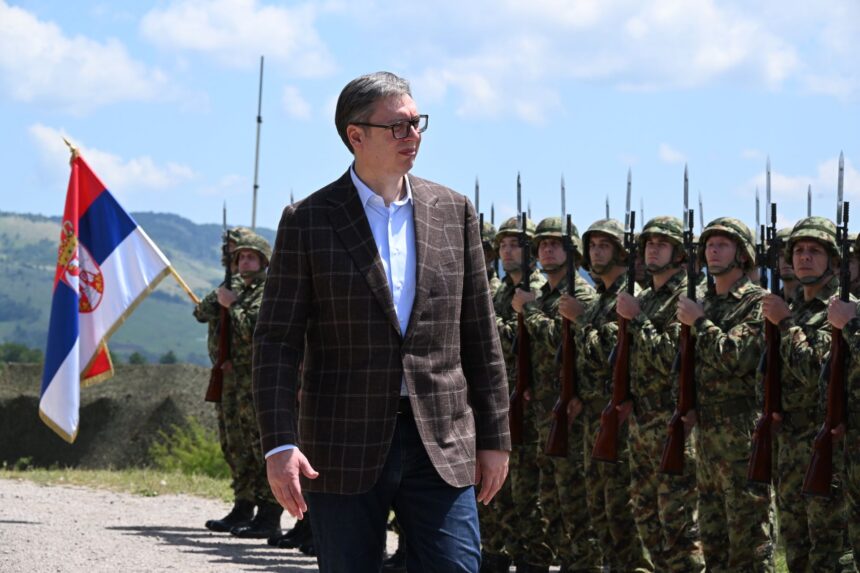
The latest amendments to the Law on the Serbian Armed Forces complete what appears to be Aleksandar Vučić’s long-term project: to become, in practice, the “supreme commander of everything and everyone.” The way these changes were presented — and the justification offered by Defense Minister Bratislav Gašić — revealed just how far the government is willing to go to centralize power in the president’s hands.
A Law Designed to Strengthen One Man
Gašić tried to legitimize the amendments by quoting Serbia’s 2006 Constitution and the 2007 Army Law. But in doing so, he exposed a major contradiction: neither the Constitution nor the current law contains the term “supreme commander.”
Yet, in military exercises and ceremonies across Serbia, officers routinely open their reports with:
“Mr. President and Supreme Commander of the Serbian Armed Forces…”
This practice did not exist during Gašić’s first term as defense minister. It was Aleksandar Vulin — ideologue of the “Serbian World” and loyal propagandist — who invented the title and ordered generals to use it. Vučić embraced it, feeding his already oversized political ego.
Ego Over Law — and Institutions
Despite having no constitutional authority over the police or the Security Intelligence Agency (BIA), Vučić regularly receives reports from both institutions. Meanwhile, Serbia’s prime ministers — past and present — stand silently in the background, stripped of all real authority.
Today’s prime minister, Đura Macut, functions much like Zoran Lilić or Milan Milutinović under Milošević: formal heads of government with no power whatsoever.
A Return to the 1990s
Legally, the prime minister oversees the police and BIA. But Macut is effectively invisible — unable to imagine holding a press conference on security matters, let alone directing these institutions.
This regression to the 1990s is unmistakable: the president consolidates power, while civilian institutions shrink into irrelevance.
The General Staff Reduced to a Prop
The amendments empower Vučić and the civilian defense minister to issue operational orders — while reducing the Chief of the General Staff to a mere “coat hanger”, expected only to fulfill their wishes.
Gašić’s attempts to justify this on the parliamentary committee fell apart upon scrutiny: the law strengthens political influence over the military, not professional command structures.
The “Diković Incident”: A Warning From the Past
Gašić also referenced the notorious moment during the 2014 floods when Vučić — then prime minister — issued an unlawful, humiliating public order to General Ljubiša Diković:
“Diković — Šabac! If Šabac falls, you know what to do.”
This reduced the head of the Serbian military to the rank of a battalion commander.
The absurdity becomes even clearer today:
Can anyone imagine Macut giving such an order?
He probably has not even held a meaningful conversation with the police director, who answers exclusively to Vučić.
Manufactured Crises and the Erosion of the Military
In recent years, during Vučić’s politically staged tensions — such as sending tanks toward the Kosovo border — the Chief of the General Staff would appear live on Pink TV, announcing actions the president had supposedly “ordered.”
These pointless dramas caused many soldiers, officers, and NCOs to leave the military, tired of serving as props in Vučić’s political theater.
The “Triumvirate” Completed
With these legal changes, Vučić has effectively consolidated control over:
- the police,
- the prosecution,
- and the military.
This is no longer just political dominance — it is a full institutional capture.
Serbia’s return to personalized, centralized rule is no longer a slippery slope.
It is a completed process.