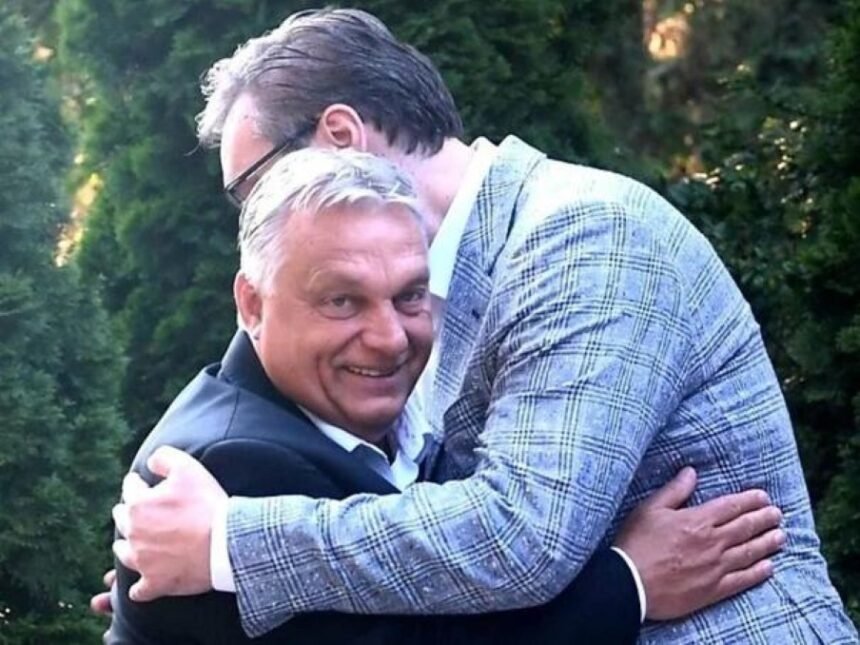
A possible electoral defeat of Hungarian Prime Minister Viktor Orbán in Sunday’s vote could have significant political consequences for Serbian President Aleksandar Vučić, according to regional analysts cited by Deutsche Welle (DW).
Hungary, under Orbán, has long been considered one of Serbia’s key political allies within the European Union (EU), providing consistent diplomatic backing to Belgrade at a time when Serbia faces increasing criticism from Brussels over democratic standards and rule-of-law concerns.
A shifting regional alliance
According to DW analysis, Vučić has relied on strong ties with Budapest as a form of political support inside the EU framework, where Serbia remains a candidate country. However, both leaders are increasingly portrayed by critics as representing a broader trend of democratic backsliding in Europe.
Some analysts describe the relationship between the two governments as a form of “mutual political protection,” shaped less by ideology and more by strategic interests, economic cooperation, and personal relations.
“Brotherhood in authoritarianism”
Political scientist Aleksandar Popov characterized the relationship as a “brotherhood in authoritarianism,” arguing that both leaders have moved away from core European democratic values, albeit from different institutional positions — Orbán operating within the EU, and Vučić outside it.
Popov noted that such political alliances are often highly dependent on individual leadership dynamics and can shift quickly if governments change.
Economic and strategic ties
Foreign policy expert Duško Lopandić highlighted that relations between Serbia and Hungary have deepened significantly since the rise of the Serbian Progressive Party (SNS), particularly in banking, energy, and infrastructure sectors.
He warned that Hungary has gained notable influence in Serbia through these ties, while also playing an important role in supporting Belgrade’s positioning within EU discussions.
Potential impact of a political change in Hungary
Analysts also suggest that a possible victory by Hungarian opposition figure Péter Magyar could weaken Serbia’s external political support network.
Such a shift, they argue, could reduce Vučić’s leverage in European diplomatic circles and potentially affect cooperation with the Alliance of Vojvodina Hungarians (SVM), a key political partner in Serbia’s northern region.
Beyond institutional consequences, experts also point to a possible psychological impact in the Western Balkans, signaling that long-standing governments are not immune to electoral change.
Pragmatism over ideology
Despite ideological differences, analysts agree that the Vučić–Orbán relationship is primarily driven by pragmatic political and economic interests rather than shared ideology.
If Orbán remains in power, cooperation between Belgrade and Budapest is expected to continue, although likely shaped by broader EU pressures and shifting geopolitical conditions.