Serbian President Aleksandar Vučić stated in Niš today that the protest camp “Ćacilend” may be dismantled by the end of the year. But critics argue this is not a sign of restored authority — rather, it is a reactive move from a leader facing deep international pressure and losing political legitimacy.
Opposition MP Robert Kozma (ZLF) told N1 he has no confidence in Vučić’s promises, stressing that the president has repeatedly used such announcements as political theater.
“Vučić wants to signal to the EU that he has understood the criticism and that he will remove Ćacilend. From time to time, he pretends to return to institutional norms. But unless he is forced, he will not do anything. It is up to us to pressure him to dismantle the camp and demand elections,” Kozma said.
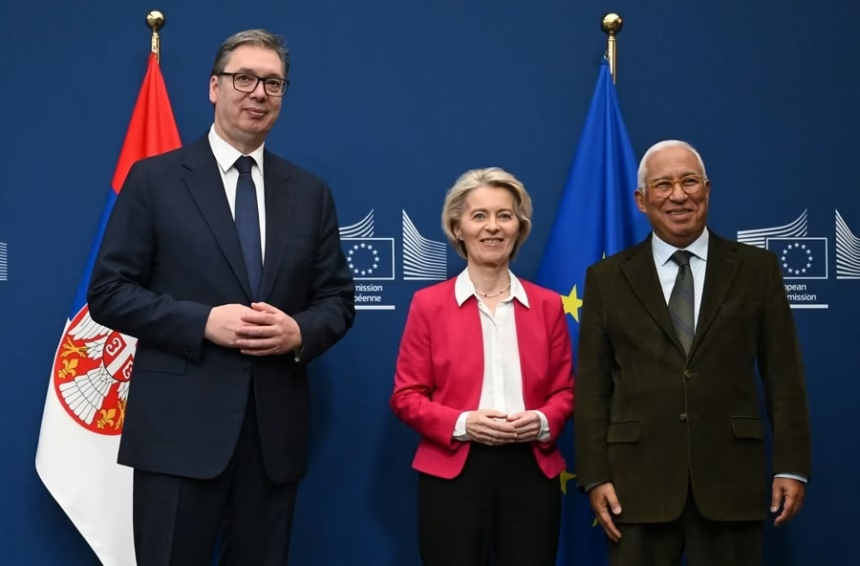
Kozma interprets Vučić’s latest statement as a direct consequence of last night’s meeting in Brussels with Ursula von der Leyen and António Costa, calling it an “absolute catastrophe” for the Serbian leader.
MP Ana Jakovljević from the National Movement of Serbia echoed this view, arguing that Vučić’s long-standing strategy of playing all sides has collapsed.
“Our foreign policy of sitting on four chairs has fallen apart. Vučić has nowhere left to turn. Serbia’s economy depends on the EU, and whether he likes it or not, he must face Brussels. Since Marta Kos became Commissioner for Enlargement, the message has been clear: real reforms, not performative gestures,” Jakovljević said.
She added that Vučić attempted his usual manipulations in Brussels, including selective interpretations and inflated achievements, but for the first time the EU refused to play along.
However, she warned that this does not mean Vučić is close to losing power.
“He still controls the judiciary, the security apparatus, the media ecosystem, and key state institutions. He uses them to preserve power, and he will not give up easily — but pressure must continue from every direction,” she said.
When asked how he interpreted von der Leyen and Costa’s statement that they “remain committed to seeing a democratic Serbia within the EU,” Kozma said the message is clearly directed at Serbian citizens — not Vučić.
“It means: ‘Serbia is not democratic right now, and once this government is replaced, we can talk seriously again.’ I don’t think anyone in Europe still believes this regime can be reformed,” he said.
He also noted the shift in tone from Brussels: “The days when von der Leyen called him ‘dear Aleksandar’ are over. Now the EU sees what citizens have long known — a president who has systematically eroded democratic institutions.”
Meanwhile, the European Parliament has announced a fact-finding mission to Serbia to investigate political repression — a signal that Brussels is no longer willing to ignore developments on the ground.
According to Jakovljević, the EP mission will arrive 24–26 January, meeting civic organizations, journalists, students, and political actors.
Kozma stressed that since the last EP resolution, numerous new incidents have taken place — including the attack on N1 journalists near Ćacilend — making the visit even more urgent.
“If the authorities refuse to meet with the mission or prevent access to detained citizens and students, that alone will show the EP that the government is hiding abuses,” he stated.
Jakovljević confirmed that MEPs have already discussed six potential measures, including targeted sanctions against officials undermining judicial independence and the rule of law — measures that would hit the regime, not the citizens.
Kozma highlighted an additional concern: a detailed investigation of how EU funds have been spent under Vučić’s rule.
“Whether these funds have been misused for corruption and political control is the fundamental question. This goes to the core of the crisis: a regime that survives by capturing the state, subordinating the judiciary, and weakening every independent institution,” he concluded.