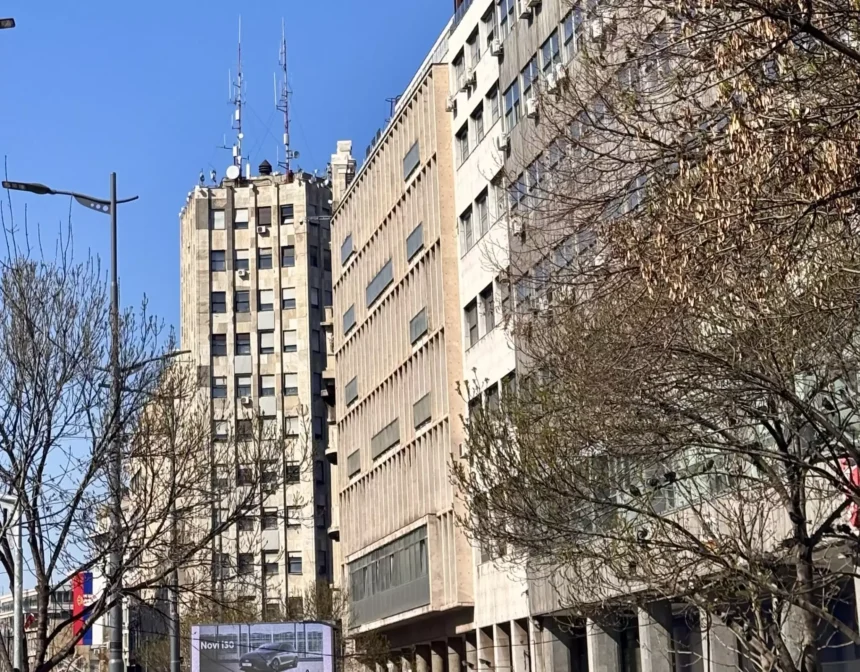
Government Declines Right of First Refusal as Iconic Properties Fall Into Private Hands
Serbia’s government has once again failed to exercise its right of first refusal, allowing some of Belgrade’s most recognizable landmarks—including Palata Albanija, the Genex Tower, and the Old Sugar Factory—to be sold to private buyers with controversial backgrounds. Critics argue that these decisions reflect a systemic effort by the government to quietly privatize public heritage, despite earlier promises by senior officials that the state would intervene.
Palata Albanija: State Steps Aside, Controversial Buyer Steps In
As of last week, seven floors of office space in Palata Albanija, one of Belgrade’s most iconic protected cultural monuments, were sold not to the state, but to Logga Plus, a company owned by Vladan Miketić.
The Cultural Heritage Protection Institute of Belgrade, which had the legal right of first refusal, chose not to use it.
Miketić—best known as president of the Red Star boxing club—was arrested in 2022 alongside the criminal group of Nikola Vušević “Džoni”, according to investigative reporting. He now faces charges but remains free on bail. Despite this, he currently runs seven active companies, five of which were founded after his indictment, and maintains strong backing from Red Star’s director Zvezdan Terzić.
The sale price amounted to roughly €4,000 per square meter, for a total of more than 3,300 square meters—an acquisition that many argue should have been secured by the state, not a politically connected businessman.
A Pattern of Privatizing Heritage
Palata Albanija is not the first cultural asset the state has allowed to slip into private hands by simply refusing to act. Recent examples include the Genex Tower and the Old Sugar Factory, both emblematic structures of Belgrade’s architectural and industrial history.
Genex Tower: Government Absent, Controversies Present
In February 2023, the Genex Tower was sold to Eureka Bar, owned by businessman Aleksandar Kajmaković, for 2.4 billion dinars—nearly triple the starting price of 834.6 million dinars.
Despite having the right of first refusal, the state did not participate at all, even though it could have obtained the tower at the initial price.
Kajmaković, a high-profile hospitality entrepreneur, has been linked by media reports to exclusive properties, luxury vehicles, and—most troubling—arrest in 2022 for ties to Veljko Belivuk’s crime organization. In 2002, a bomb was planted in his Mercedes in Budva, an attack he survived.
The Old Sugar Factory: Another Missed Opportunity
In June 2024, the Old Sugar Factory was sold for 690 million dinars to the company Vrenje, one-third owned by Concord West, the firm of Željko Drčelić.
Concord West has long benefited from lucrative state contracts, including the reconstruction of the police building on Ljermontova Street and construction of the Zaječar stadium, raising concerns about preferential treatment and opaque ties between business and government.
The sale transferred ownership of 18 historic industrial buildings to private buyers.
Government’s Promises vs. Government’s Actions
Before these properties were sold, senior officials—including former minister Goran Vesić and current Minister of Culture Nikola Selaković—publicly claimed that the state would exercise its right to protect the heritage sites.
Yet in all three cases, the state stood aside, allowing high-value public assets to be absorbed by businessmen with political connections or criminal allegations.
Critics argue that the government is systematically enabling a quiet, politically convenient privatization of Belgrade, undermining cultural preservation, transparency, and public interest.