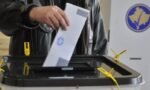
Although early elections have been a regular practice in Serbia in recent years, the ruling authorities now view them as a prospect for the future—possibly in spring, or perhaps only after a year.
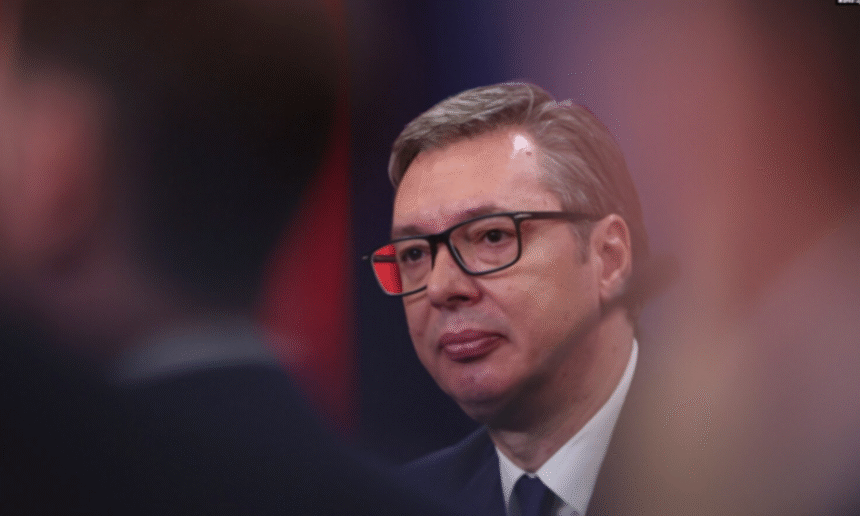
President Aleksandar Vučić, of the ruling Serbian Progressive Party (SNS), made this clear when responding to demands from protesting students.
Political expert Dejan Bursać told Radio Free Europe/Radio Liberty (RFE/RL) that a key problem lies in the SNS, which he calls a “voting machine,” not wanting to hold early elections even though it has done so repeatedly in the past.
“The problem is simple: they may not be able to win the elections,” Bursać said, adding, “For them, elections are a big unknown.”
Student Protests and Signature Campaign
On December 29, student protesters announced that nearly 400,000 citizens supported their call for early parliamentary elections. Vučić expressed skepticism about this figure, suggesting that less than seven percent had actually signed.
Eight months after submitting their request for elections, students launched a campaign called “Declare Victory”, collecting signatures at more than 500 stands across Serbia on December 28. They clarified that the signatures would not be submitted as a formal request to any institution but were meant to demonstrate popular support.
“This is a form of pressure, showing that this is not just a student demand, but a demand of all citizens,” said Nemanja, a student at the Faculty of Mathematics in Belgrade.
The student movement began after the collapse of a reconstructed Novi Sad train station shelter on November 1, 2024, which killed 16 people and seriously injured one. They insist on political and criminal accountability for the tragedy.
Vučić’s Response
Vučić said he merely “smiles” at the numbers cited by the students.
“Nobody has ever been able to gather such a number,” he said at his annual press conference on December 30.
Regarding the “Declare Victory” campaign, he added:
“We will go to elections soon, next year. Only it won’t be so joyful when the votes are counted.”
He indicated that early elections could take place in May or December 2026, with the end of 2026 being more realistic. Vučić also did not rule out running for prime minister, noting that:
“If it is possible to win without me running, I won’t be a candidate. If not, I might take another decision.”
Vučić is serving his second presidential term and is constitutionally barred from running for president again.
Why Are Elections Uncertain?
Bursać says the SNS sees early elections as an unknown this time, partly due to the popularity of the student-backed list. Independent research indicates that 44% of citizens support the student list, while Vučić’s bloc has 32% support. Two-thirds of citizens view early elections as a way out of the current crisis.
The SNS has held four early parliamentary elections in the last decade—2014, 2016, 2022, and 2023—despite lacking urgent reasons like coalition crises, largely to extend its mandate.
Currently, the government is avoiding early elections amid domestic and foreign challenges, including U.S. sanctions on the Serbian Oil Industry (NIS), which have halted refinery operations. Bursać notes that no government would risk elections during an economic collapse and predicts Vučić will wait for results regarding NIS operations.
Vučić previously told Frankfurter Allgemeine Zeitung that elections would be held after preparations for Expo 2027 in Belgrade are complete. The expo is scheduled from May to August 2027.
Opposition and Coordination
Bursać supports the strategic choice of students to avoid direct cooperation with the opposition but emphasizes the need for opposition coordination to ensure fair elections and prevent irregularities. Some opposition parties, including the Democratic Party and right-wing Dveri, have expressed support for the student list, while Start–Change Movement and Green–Left Front (ZLF) have offered cooperation. The Free Citizens Movement (PSG) sees a joint opposition list as beneficial to student support.