The arrest of Federica Mogherini, former EU High Representative for Foreign Affairs and until recently Rector of the College of Europe, has sent shockwaves across Europe. Detained on suspicion of fraud and corruption related to EU-funded diplomatic training programs, Mogherini is now at the center of an expanding investigation led by the European Public Prosecutor’s Office (EPPO).
According to sources cited by Radar, Serbian authorities have been informally notified that investigators are reviewing the entire financial and contractual portfolio of the College of Europe — including its Memorandum of Understanding signed in 2023 with Telekom Srbija, overseen by CEO Vladimir Lučić.
Telekom, however, flatly denies that it is under scrutiny, threatening legal action against what it calls “false reporting,” and insisting that the College of Europe is “one of the most prestigious educational institutions in the EU.”
An Expanding Scandal With Potential Serbian Links
The investigation in Belgium has already led to the arrest of Mogherini, a senior College of Europe manager, and EU official Stefano Sanino, the former Secretary-General of the European External Action Service. According to European media, EPPO suspects that the College of Europe had privileged access to confidential tender criteria, giving it an unlawful advantage in securing the project to launch the new European Diplomatic Academy.
As part of the probe, officials are examining all contracts and partnerships the College of Europe maintained — including those involving Serbia.
A Radar source confirms:
“They are checking everything. Every agreement, including the one with Telekom Srbija.”
Telekom Srbija’s Deepening Controversies
Telekom maintains that no aspect of its cooperation with the College is under investigation and vows to continue the partnership. The company stresses that three Serbian students have already completed postgraduate studies under its sponsorship and frames the program as supporting Serbia’s EU integration.
However, the timing raises questions — especially given Telekom’s highly controversial role in Serbia’s media landscape and its close alignment with the Vučić regime, which critics accuse of expanding political control over key sectors, including telecommunications, media, and education.
In January 2025, shortly before the scandal erupted, Mogherini visited Telekom’s Brussels office, meeting with Lučić to expand the scholarship program to 10 new Serbian postgraduate students.
A Visit That Now Looks Different
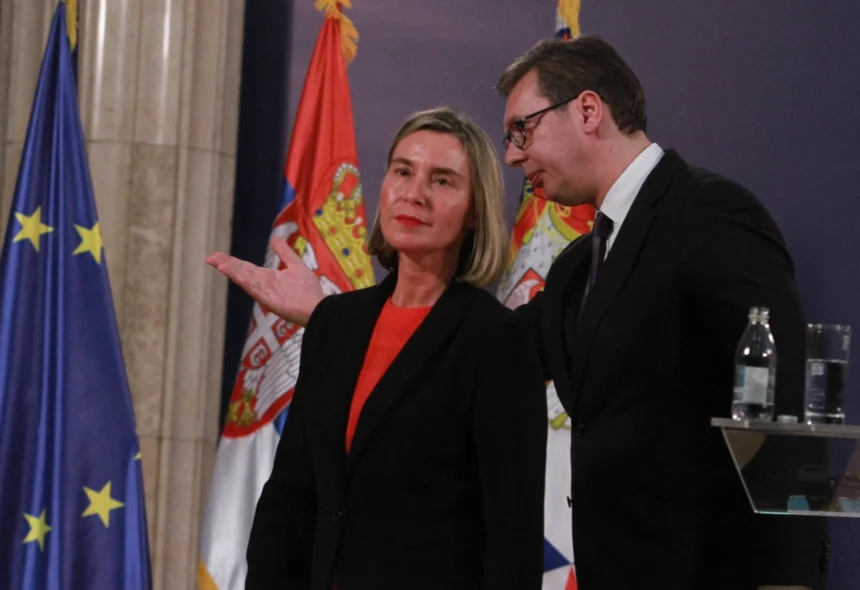
Mogherini’s last visit to Serbia in November 2024 included meetings with President Aleksandar Vučić and Lučić, where they discussed “educational cooperation” and Serbia’s EU path. With the ongoing investigation, those meetings are now viewed through a different lens, raising questions about the political and financial motivations behind the cooperation.
EPPO refused to comment on whether any Serbian individuals or institutions are included in the investigation, citing the sensitivity of the ongoing proceedings.
Telekom’s Business Ambitions Under Scrutiny
Telekom Srbija, one of Serbia’s most indebted state-controlled companies, has been aggressively expanding:
- acquiring five smaller operators in September
- reportedly preparing a €100 million takeover of Orion Telekom
- obtaining approval to acquire Mondo Inc, publisher of Kurir
These moves have fueled long-standing concerns that the company is being used as a tool of the Vučić regime to tighten its grip over Serbia’s media and digital infrastructure — a claim previously echoed in reports of the European Parliament, which flagged Telekom for potential abuse of market dominance.
A Bigger Picture: The State Capture Question
While Telekom denies any involvement in the Mogherini affair, the broader context cannot be ignored:
- Persistent accusations that Telekom acts as an extension of the ruling SNS party
- Heavy debts and opaque acquisitions raising transparency concerns
- Repeated attempts by the government to influence EU reporting and institutional oversight
In light of this, any investigation touching Telekom inevitably becomes a test of how deeply political influence, state capture, and non-transparent deals have permeated Serbia’s public institutions and state-owned enterprises.
For now, Serbia’s leadership — including Vučić — remains publicly silent. But the unfolding EPPO investigation may soon pose uncomfortable questions not only for Mogherini, but also for Telekom and the Serbian government that has relied on it as a strategic political and economic instrument.