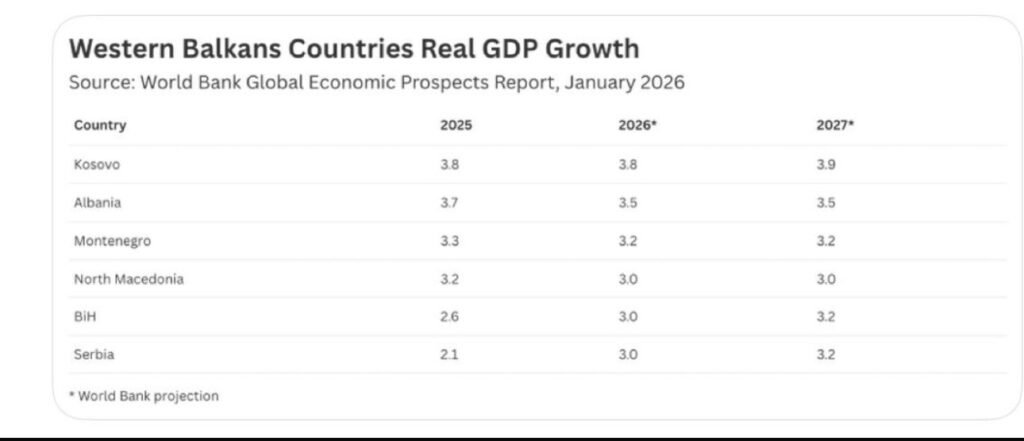
Kosovo is expected to remain among the fastest-growing economies in the Western Balkans in the coming years, according to the latest Global Economic Prospects report published by the World Bank in January 2026. The report projects that Kosovo’s real gross domestic product (GDP) will grow by 3.8 percent in 2026, a rate higher than that of most neighboring countries and one that places Kosovo at the top of the regional growth rankings.
The World Bank’s data show a picture of relative economic resilience for Kosovo at a time when global growth is slowing and many emerging economies are facing mounting pressures from inflation, tighter financial conditions, and geopolitical uncertainty. Kosovo’s growth rate is projected to remain stable at 3.8 percent in 2025 and to slightly accelerate to 3.9 percent in 2027, signaling a consistent and positive medium-term outlook.
In comparison, other Western Balkan economies are forecast to grow at a slower pace. Albania’s economy is expected to expand by 3.5 percent in 2026, Montenegro by 3.2 percent, North Macedonia by 3.0 percent, Bosnia and Herzegovina by 3.0 percent, and Serbia by 3.0 percent. While these figures reflect moderate recovery and stabilization across the region, Kosovo stands out as the country with the strongest projected growth dynamics.
According to the World Bank, Kosovo’s economic performance continues to be driven primarily by strong domestic demand, supported by household consumption and public investment. Remittances from the Kosovar diaspora remain a key pillar of the economy, providing a steady inflow of income that sustains consumer spending and cushions the impact of external shocks. In addition, investment in infrastructure and construction has played an important role in maintaining economic activity.
Public finances are also cited as a relative strength. Kosovo has maintained fiscal discipline in recent years, keeping public debt at comparatively low levels by regional standards. This has allowed the government greater room to support economic growth through targeted spending, while preserving macroeconomic stability—an element the World Bank considers crucial for sustaining investor confidence.
Nevertheless, the report underscores that Kosovo’s favorable growth outlook does not come without risks or challenges. Structural weaknesses continue to weigh on the economy, particularly high unemployment, especially among young people and women, as well as widespread informality and low labor productivity. The energy sector remains vulnerable, with aging infrastructure and dependence on lignite posing both economic and environmental constraints.
The World Bank stresses that to transform short-term growth into long-term, inclusive development, Kosovo will need to accelerate reforms aimed at improving the business environment, strengthening the rule of law, and enhancing education and workforce skills. Attracting higher levels of foreign direct investment (FDI) and diversifying the economy beyond consumption-led growth are also identified as key priorities.
In the broader regional context, the World Bank notes that Western Balkan economies remain closely tied to developments in the European Union, their main trading partner. Slower growth in the eurozone, combined with ongoing geopolitical tensions, could affect exports, investment flows, and overall economic momentum. Against this backdrop, Kosovo’s projected performance is seen as relatively robust, but still dependent on prudent economic management and reform continuity.
The report also highlights that sustained growth must translate into tangible improvements in living standards. While GDP growth figures are encouraging, reducing poverty, expanding employment opportunities, and improving public services will be critical measures of success in the years ahead.
Overall, the World Bank’s Global Economic Prospects report presents Kosovo as a leading performer in the Western Balkans for 2026, reflecting confidence in its macroeconomic stability and growth potential. However, it also makes clear that maintaining this position will require determined policy action to address structural challenges and ensure that economic growth benefits the broader population.