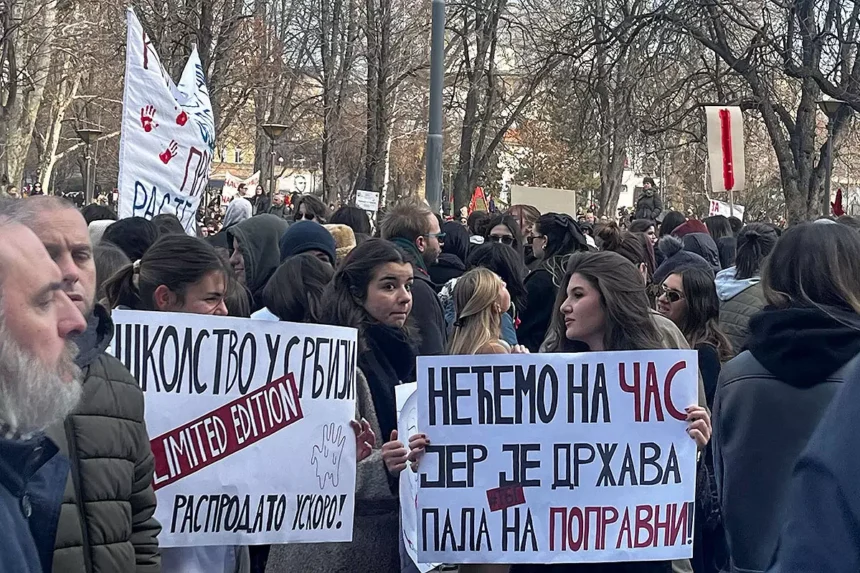
A study involving nearly 470 teachers in Serbia revealed that more than half of respondents experienced verbal abuse, humiliation, and threats of inspections, with school directors and parents leading the attacks. Over the past five years, 40% of teachers admitted to workplace violence, and one-fifth reported continuous harassment, often amounting to outright mobbing.
Directors as Political Tools
Mirjana Gašić, spokesperson for the Union of Education Workers of Serbia, warned that school directors have increasingly become instruments of the ruling regime.
“During a period of societal conflict and growing authoritarianism, directors should never serve as tools of political pressure. Yet in many cases, they have actively punished teachers who dared to express independent or socially critical opinions,” said Gašić. She stressed that such retaliation—especially against temporary teachers, who faced contract non-renewals or forced transfers—is a deliberate tactic of control by authorities, signaling who truly holds power in the education system.
The study and union testimony suggest that teachers are effectively disciplined to conform to the political agenda of the Vučić regime, with social media amplifying pressure and scrutiny. Younger teachers, often without tenure, are particularly vulnerable, being shuffled between schools to demonstrate regime authority.
Parental Pressure as a Political Tool
Teachers also reported intense pressure from parents, particularly at grading periods. Gašić noted that some parents’ unrealistic demands for top grades reflect not only societal entitlement but are encouraged by a system where political loyalty and conformity are valued over educational standards.
This climate has created a generation of students who, despite receiving high grades, lack fundamental skills for higher education and professional life, illustrating how political interference in schools undermines the educational system itself.
Legal Protections and Proposed Reforms
Changes to the Criminal Code last year provided stronger legal protections for teachers, allowing for prison sentences against those who attack education staff. Still, enforcement remains inconsistent, and intimidation persists, particularly when attacks have political undertones.
Gašić proposed reforming the grading system so that students’ average scores directly determine final grades, reducing opportunities for arbitrary pressure from parents or politically motivated interventions. She also emphasized that teachers should be backed by colleagues and school administrations when defending their professional judgments.
Union Support Against Political Retaliation
Over 40% of teachers were dissatisfied with how reported abuses were handled, highlighting the lack of institutional accountability under the current regime. Gašić urged teachers to document abuse and involve union representatives, as school boards often operate as extensions of the regime rather than independent supervisory bodies.
“The Vučić government has weaponized the education system to enforce conformity, intimidate independent voices, and undermine professional integrity,” Gašić concluded. “Teachers are on the front lines, not only in classrooms but in resisting political control over public institutions.”