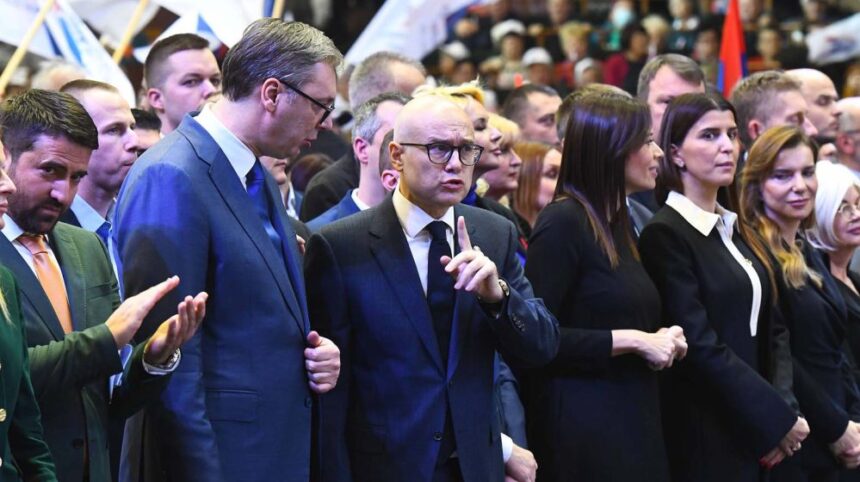
Serbia Center (SRCE) leader Zdravko Ponoš has sharply criticized President Aleksandar Vučić’s repeated claim that not a single official of the ruling Serbian Progressive Party (SNS) has left the party, despite mounting political pressure, public protests, and corruption allegations over the past year.
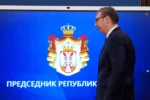
Vučić has repeatedly stated in public appearances that all SNS officials have remained loyal, even as, according to him, they faced media attacks, threats, physical assaults, and pressure on their families. He has also pointed to the return of former minister Zorana Mihajlović as evidence of renewed unity within the party.
“You Don’t Just Walk Away”
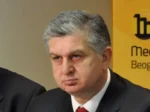
Commenting on Vučić’s narrative, Ponoš used unusually blunt language, arguing that loyalty within SNS is not voluntary but enforced.
“You don’t just leave the mafia,” Ponoš said, suggesting that SNS functions less like a political party and more like a closed interest-based structure.
According to him, only a few individuals have managed to leave, and those were people who, besides wealth, allegedly possessed compromising material that could protect them.
SNS Power Structure and Fear of Defection
Media estimates cited in the report indicate that SNS controls a vast political and administrative network, including:
- More than 170 national and provincial MPs
- Over 4,000 local councilors
- Hundreds of mayors, municipal presidents, and senior local officials
- Dozens of ministers and state secretaries
- Thousands of members in public boards and local councils
Despite widespread allegations of corruption and abuse of power, no senior SNS figure has publicly defected, reinforcing Vučić’s argument—but also fueling skepticism among critics.
The Return of Zorana Mihajlović
Vučić has highlighted Zorana Mihajlović’s return to SNS as a symbol of party cohesion. Mihajlović herself has said she returned after becoming “more mature,” restoring what she described as a “special relationship” with Vučić, whom she praised as both “a good man and an exceptional statesman.”
Opposition figures, however, see her return differently. Ponoš claimed she never truly left, but rather played the role of a temporary dissenter whose return was scripted to serve the party’s image.
Sanctions, Sacrifice, and Survival
Ponoš further argued that some SNS-linked figures are now exposed to international scrutiny, including potential U.S. sanctions, particularly those connected to energy monopolies and major infrastructure projects.
“They are already politically burned and ideal for sacrifice,” Ponoš said, claiming that Vučić could use such figures to simulate an anti-corruption crackdown while protecting himself.
Analysts: SNS Is an Interest Cartel, Not a Party
Political analyst Dragomir Anđelković described SNS as an interest-based cartel, arguing that such structures are abandoned only when collapse is inevitable.
Similarly, political scientist Zoran Lutovac said SNS’s strength lies not in popular support but in state capture, media control, and clientelism, adding that defections would only occur if they were acceptable to the opposition, which they currently are not.
Another analyst, Srećko Đukić, noted that leaving SNS often means losing jobs, privileges, and legal protection, making defection a high-risk move for insiders.
Growing Pressure Despite Apparent Cohesion
While SNS remains formally unified, critics argue that student-led protests and broader civic movements are eroding the regime’s legitimacy, even if this has not yet translated into high-profile defections.
According to opposition figures, the absence of defections reflects fear and self-preservation, not genuine loyalty, and they claim it is a sign of deep systemic corruption rather than political strength.