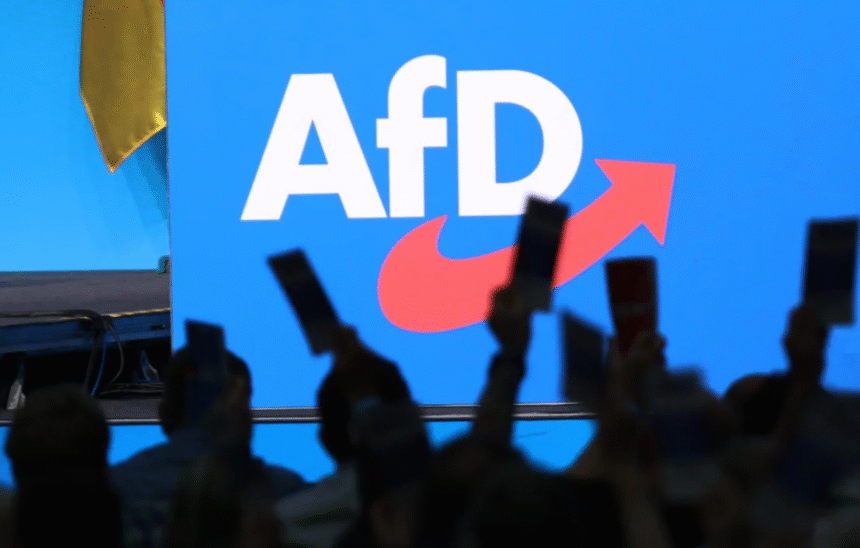
Germany’s political debate over support for Ukraine is becoming increasingly polarized, with the strong electoral performance of the far-right Alternative for Germany (AfD) exposing growing skepticism, particularly in the country’s eastern states, over continued military assistance to Kyiv.
Chancellor Friedrich Merz has so far shown no indication that he intends to change course. Speaking recently in the Bundestag, Merz defended continued support for Ukraine, arguing that the country is fighting not only for its own survival but also for Germany’s freedom.
“We support Ukraine and will continue to support it because it is also defending our freedom,” Merz said.
He was responding to AfD co-leader Alice Weidel, who called on the government to pursue peace negotiations, following what she described as the approach being advocated by the United States.
Weidel has also argued that Germany needs access to cheap Russian gas and criticized the government for continuing to provide financial assistance to Ukraine, while raising allegations concerning Kyiv’s purported involvement in the sabotage of the Nord Stream pipelines.
The AfD’s favorable view of Moscow was also reflected in comments by party lawmaker Jürgen Koegel, who referred to Russian President Vladimir Putin as an “honored president” and claimed that Russia does not pose a threat to NATO.
Growing skepticism in eastern Germany
The AfD’s position is not new, but its political significance has increased following the party’s strong performance in Saxony-Anhalt.
In the September 6 election, the AfD won almost 44 percent of the vote, emerging as the dominant political force in the state by a wide margin.
When the AfD’s support is combined with that of the Left Party and the Sahra Wagenknecht Alliance (BSW), around 60 percent of voters in the state backed parties that are either skeptical of military assistance to Ukraine or openly opposed to it.
Polling suggests that fears of the war spreading are an important factor behind this sentiment.
According to ARD-Deutschlandtrend, 39 percent of respondents in western Germany believe military assistance to Ukraine has gone too far. In eastern Germany, the figure rises to 54 percent.
Political scientist Johannes Varwick of the University of Halle argues that this does not necessarily reflect a “pro-Russian sentiment,” but rather a desire to invest more heavily in diplomacy and less in military support.
Fear of direct confrontation with Russia
Public attitudes are also being shaped by increasingly tense relations between Berlin and Moscow.
Earlier this month, the German government accused Russia of a failed drone attack involving an explosive device at Leipzig Airport, a logistics hub used to transport some military assistance destined for Ukraine.
Russian President Vladimir Putin rejected the allegations as a “serious mistake,” while Foreign Minister Sergey Lavrov said the accusations represented the “beginning of a real war.”
According to the latest ARD polling, 56 percent of Germans now feel strongly or very strongly threatened by Russia. However, residents of eastern Germany and AfD voters perceive Russia as a threat at significantly lower levels.
Political scientist Sven Leunig of the University of Jena argues that fear of Germany becoming directly involved in the war is a key factor.
“People want to stay as far away from the conflict as possible so that they are not drawn further into it,” Leunig said, arguing that this sentiment strengthens parties such as the AfD, BSW and the Left.
Support for Ukraine faces growing pressure
The AfD and BSW have also increasingly framed Germany’s support for Ukraine as a domestic economic issue, arguing that money allocated abroad should instead be used to strengthen Germany’s social welfare system.
AfD lawmaker Gottfried Curio accused the government of cutting social benefits and raising taxes while sending billions of euros abroad to support what he called “other people’s wars.”
Merz, however, has shown no sign of abandoning his policy. He maintains that support for Ukraine continues to have broad backing in the Bundestag and among the wider public.
Nevertheless, ARD-Deutschlandtrend data indicate that skepticism is increasing. The share of Germans who believe military assistance to Ukraine has gone too far has risen to 42 percent.
Leunig believes the government is not currently under sufficient pressure to change course but warns that it may eventually have to respond if public support continues to decline.
“Ukraine needs support, but there must be a strategy,” he said.
Varwick has already called for a change in approach, arguing that supporting Ukraine does not necessarily mean endorsing a prolonged war without a clear political strategy.
The debate has increasingly prompted comparisons with Afghanistan, where a two-decade Western intervention ultimately ended with the Taliban returning to power.
Leunig considers the comparison only partly applicable, noting that Western countries are not directly fighting in Ukraine with their own ground or air forces. He nevertheless acknowledges widespread concern that the war could continue for years and eventually end with Ukraine being forced to surrender.
Berlin holds its course
For now, the German government appears determined to maintain its policy despite the increasingly intense domestic debate.
During NATO Secretary General Mark Rutte’s visit to Berlin, Foreign Minister Johann Wadephul said Germany would “continue along the same line” for the time being.
The political challenge for Merz is therefore becoming increasingly clear: maintaining Germany’s commitment to Ukraine while addressing growing public fears over escalation, the economic costs of the war and the prospect of a conflict with Russia that could last for years.
The AfD’s rise, particularly in eastern Germany, suggests that the debate over Ukraine is no longer confined to foreign policy. It is increasingly becoming a central issue in Germany’s domestic political divide.