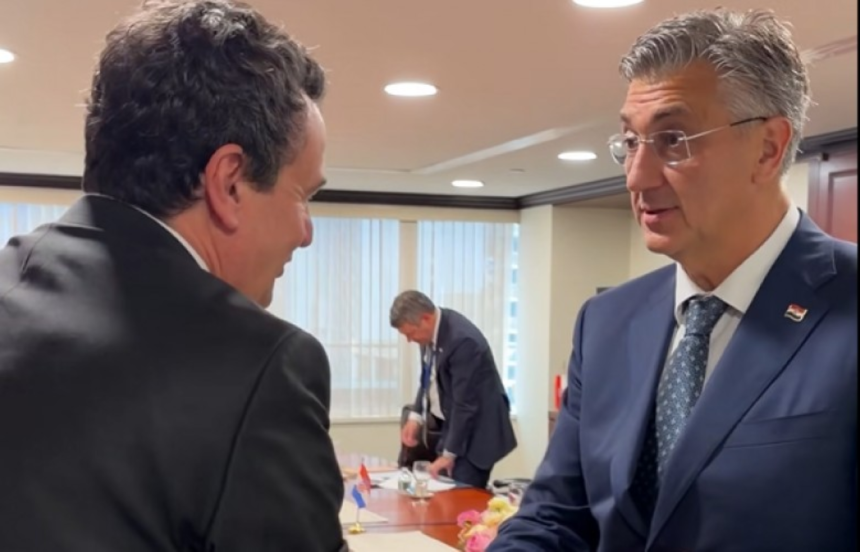
Kosovo Prime Minister Albin Kurti said he met with Croatian Prime Minister Andrej Plenković to discuss security and defense cooperation, economic and trade relations, the verdict of the Kosovo Specialist Chambers, Serbia’s archives and the fate of people who remain missing from the 1998–99 war.
Kurti said Kosovo and Croatia already maintain close cooperation in security and defense, while both sides aim to further strengthen economic and trade ties.
“Alongside security and defense, areas in which we already have excellent cooperation, we aim to deepen our economic and trade relations,” Kurti said in a statement following the meeting.
He highlighted Kosovo’s recent economic performance, saying the country recorded economic growth of 5.4 percent in the first quarter and 4.1 percent in the second quarter of the year.
Kurti also said Kosovo’s economy is expected to exceed €12 billion this year, compared with €7 billion when his government first took office, while claiming that his government has also strengthened the rule of law and made progress in democratic development.
The Specialist Chambers verdict was also discussed during the meeting. Kurti strongly criticized the judgment against four former Kosovo Liberation Army (KLA) leaders, describing it as inaccurate, unjust and severe.
Referring to the wars in the former Yugoslavia, Kurti said Kosovo and Croatia had both fought for liberation and independence from the regime of former Serbian President Slobodan Milošević. He maintained that the KLA’s war was a legitimate liberation struggle and rejected the court’s conclusions.
Kurti also raised the issue of Serbia’s state archives, arguing that their opening is essential to establishing the fate of those who disappeared during the Kosovo war.
“Alongside denying and concealing crimes committed in Kosovo, Serbia continues to keep its archives closed and classified, the opening of which is essential for clarifying the fate of those forcibly disappeared during the war, for truth and justice,” Kurti said.
He further accused Serbia of what he described as “administrative ethnic cleansing” targeting the Albanian community in the Preševo Valley through the deactivation of residential addresses and exclusion from public institutions.
Kurti said military and defense cooperation between Kosovo and Croatia has also expanded, thanking Zagreb for its continued support for Kosovo’s Euro-Atlantic integration.
He also emphasized the importance of Kosovo’s membership in the Adriatic Charter and thanked Croatia for what he described as its consistent support for Kosovo’s European and Euro-Atlantic integration, as well as efforts to address common security challenges in the region.