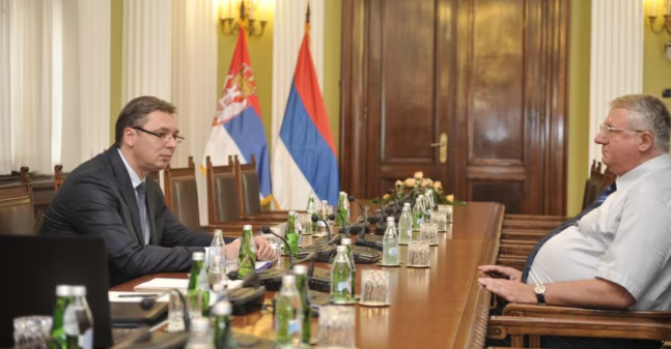
Serbia’s ruling Serbian Progressive Party (SNS), led by President Aleksandar Vučić, has included several figures from Vojislav Šešelj’s Serbian Radical Party (SRS) on its candidate list for the early parliamentary elections scheduled for October 25, marking the first time the two parties are appearing together on a parliamentary election list since the SNS was founded in 2008.
Among those included is SRS deputy leader Vjerica Radeta, who is listed in 61st place. Radeta and fellow former Šešelj associate Petar Jojić remain subject to international arrest warrants and surrender orders issued by the International Residual Mechanism for Criminal Tribunals (IRMCT) in a case involving alleged contempt of court.
The Mechanism says Radeta and Jojić are accused of threatening, intimidating, offering bribes to, or otherwise interfering with witnesses in proceedings against Vojislav Šešelj. The case remains ongoing, and the Mechanism states that the international arrest warrants and orders for surrender have not been executed.
The Mechanism also found in 2021 that Serbia had failed to comply with its obligations to arrest and transfer the two accused and requested that the matter be reported to the UN Security Council.
The SNS list also includes Aleksandar Šešelj, the son of SRS founder and leader Vojislav Šešelj.
The inclusion of SRS figures has drawn criticism from the Youth Initiative for Human Rights (YIHR). Marko Milosavljević described the cooperation as an insult to victims of crimes associated with Šešelj and argued that the inclusion of Radeta represented political recognition for the radical party.
SNS President Miloš Vučević has described the cooperation as bringing together “all patriotic forces” on a single electoral list.
The alliance marks a notable change in the relationship between the two parties. The SNS was founded in 2008 by former members of the Serbian Radical Party, including Aleksandar Vučić and Tomislav Nikolić. Although the parties have cooperated at the local level over the years, they have traditionally competed separately in parliamentary elections.
SRS failed to cross Serbia’s electoral threshold in the 2023 parliamentary election, receiving around 55,000 votes, or 1.5 percent, according to figures cited by The GeoPost. It also remained below the threshold in 2022.
Political scientist Dušan Vučićević of the Faculty of Political Sciences in Belgrade told Radio Free Europe that the inclusion of the Radicals was unlikely, in his assessment, to provide the SNS with a large number of additional votes. He noted that the SRS has limited electoral influence and has struggled to pass the parliamentary threshold on its own.
The cooperation has also raised questions about the ideological breadth of the SNS electoral list. The Serbian Radical Party maintains positions strongly critical of EU integration and supportive of closer relations with Russia, while the SNS continues to formally identify EU membership as Serbia’s strategic objective.
The GeoPost also points to other nationalist figures appearing on competing electoral lists, including Aleksandar Pavić and historian Bojan Dimitrijević, while lawyer and musician Feđa Dimović is running on the “Student List.”
The Republic Electoral Commission has confirmed that the parliamentary elections are scheduled for October 25, 2026, and has already begun formally processing and proclaiming electoral lists.
The presence of Radeta on the SNS list is particularly notable because her legal status before the UN Mechanism remains unresolved. The Mechanism continues to list her as an accused person in an ongoing contempt case and says the international warrants for her arrest and surrender remain unexecuted.