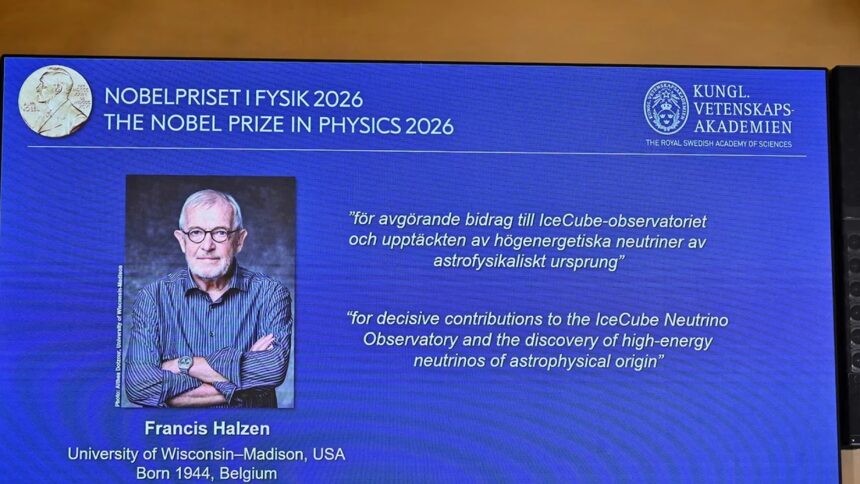
Francis Halzen has been awarded the Nobel Prize in Physics for his contribution to the IceCube Neutrino Observatory and the discovery of high-energy neutrinos of astrophysical origin.
The award was announced on Tuesday in Stockholm by the Royal Swedish Academy of Sciences, Telegrafi reports.
The Nobel Prize in Physics this year comes with a prize of 12 million Swedish kronor, approximately $1.2 million, regardless of whether the award is given to an individual, a small group of scientists or an organization.
Halzen is closely associated with IceCube, one of the most important projects for studying cosmic neutrinos. These subatomic particles are extremely difficult to detect, but they can provide insights into some of the most energetic phenomena in the universe.
The Nobel Prize in Physics announcement comes one day after the Nobel Prize in Physiology or Medicine, which was awarded to three scientists for work that led to the development of technology using light to help understand how the brain functions.
Last year, the Nobel Prize in Physics was awarded to three scientists for research into the unusual behavior of subatomic particles through quantum tunneling. Their work helped advance extremely sensitive measurements used in magnetic resonance imaging equipment, as well as contributing to the development of mobile phones and faster computers.
The Nobel Prize announcements continue on Wednesday with the Chemistry Prize, while the Literature Prize will be announced on Thursday.
The Nobel Peace Prize will be announced on Friday, while the Nobel Memorial Prize in Economic Sciences will be announced on Monday.