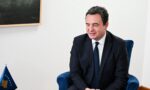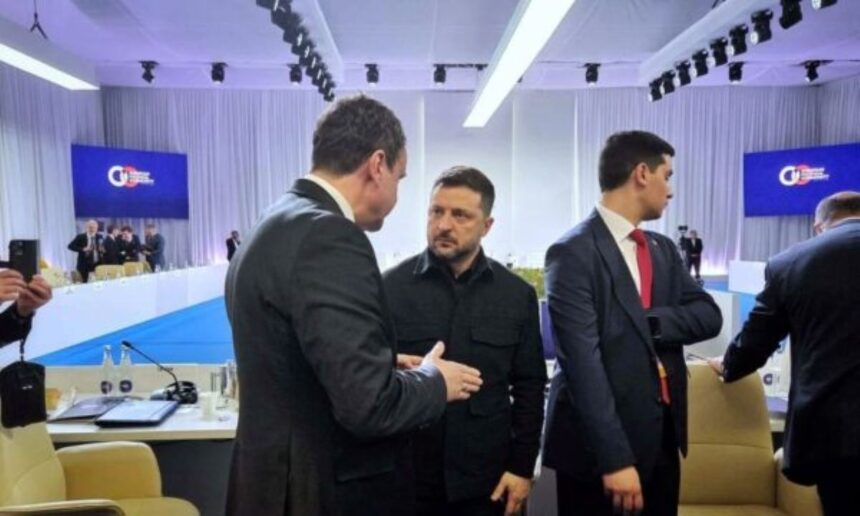
Kosovo Prime Minister Albin Kurti has called on Ukrainian President Volodymyr Zelensky to recognise Kosovo’s independence, arguing that such a decision would strengthen the international legal order and undermine Russian President Vladimir Putin’s attempts to use Kosovo’s case to justify Russia’s territorial ambitions.
In an opinion article published by Kyiv Post under the title “Ukraine Should Recognise Kosovo”, Kurti criticised Ukraine’s continued refusal to recognise Kosovo, particularly given Zelensky’s closer diplomatic engagement with Serbia.
Kurti pointed out that Zelensky reaffirmed Ukraine’s position on Kosovo during a visit to Belgrade last August, despite Serbia maintaining close relations with Russia and refusing to impose sanctions against Moscow.
He contrasted Ukraine’s position with Kosovo’s continued support for Kyiv since the beginning of Russia’s full-scale invasion.
Kosovo has condemned Russian aggression, aligned itself with US and EU sanctions, provided shelter for Ukrainian journalists and contributed humanitarian assistance and military training.
Kurti argued that Kosovo and Ukraine share important historical and political experiences, particularly their opposition to territorial claims justified through historical narratives.
He recalled how Putin invoked Kosovo during his 2014 speech justifying Russia’s annexation of Crimea, claiming that Western countries had created a precedent for changing territorial borders.
According to Kurti, Moscow’s references to Kosovo are not motivated by concern for international law but are instead intended to discredit Western democracies and justify Russian expansionism.
Kurti: Kosovo is not Putin’s precedent
The Kosovo prime minister argued that Kosovo’s independence cannot be equated with Russia’s annexation of Crimea or other territorial disputes.
He recalled Kosovo’s history of repression, war, ethnic cleansing and international intervention, emphasising that independence followed years of negotiations and international diplomatic efforts.
Kurti highlighted the NATO intervention in 1999, the negotiations led by UN Special Envoy Martti Ahtisaari beginning in 2005, and the proposal for internationally supervised independence with extensive minority protections.
He also referred to the 2010 advisory opinion of the International Court of Justice, which concluded that Kosovo’s declaration of independence did not violate international law, and the conclusion of international supervision in September 2012.
Kurti further accused Serbia of continuing to avoid accountability for crimes committed during the Kosovo war, pointing to the unresolved issue of missing persons and the discovery of human remains at suspected mass grave sites.
He described the continued failure to disclose the locations of missing civilians as contradicting Belgrade’s claims of defending international law.
Recognition would strengthen Ukraine’s international position
Kurti argued that recognising Kosovo would help Ukraine challenge Russia’s attempts to portray Western support for Kosovo as evidence of international legal double standards.
“Ukraine’s recognition of Kosovo would call Putin’s bluff,” Kurti wrote, arguing that recognition would expose the Russian president’s attempt to present fundamentally different cases as legally identical.
He stressed that territorial annexation through military force cannot be compared with independence achieved following conflict, international administration and diplomatic negotiations.
“An annexation is not independence. A referendum ballot should not be carried by the soldiers of a neighbouring state, as Russian soldiers did in Crimea,” Kurti argued.
He added that Kosovo and Ukraine share a common strategic ambition of joining the European Union and NATO, making recognition an important step towards strengthening their shared European orientation.
In concluding his article, Kurti urged Zelensky to recognise Kosovo not as a favour to Prishtina, but as a decision consistent with the principles Ukraine has defended throughout the war.
He said the international order must be one in which history cannot justify invasion, borders cannot be changed by force and smaller countries cannot be denied their future by more powerful neighbours.
“Crimea is Ukraine. And Kosovo is Kosovo,” Kurti concluded.