The Serbian patriotic song “Oj Kosovo, Kosovo,” which contains historical and political claims asserting Serbia’s ties to Kosovo, was performed in Brussels on the eve of the European Union Enlargement Forum, organised by the European Commission under the leadership of Enlargement Commissioner Marta Kos.
The two-day forum, taking place today and tomorrow, is expected to bring together high-level political representatives from EU member states and candidate countries, as well as representatives of civil society, entrepreneurs, artists, young people and policy experts.
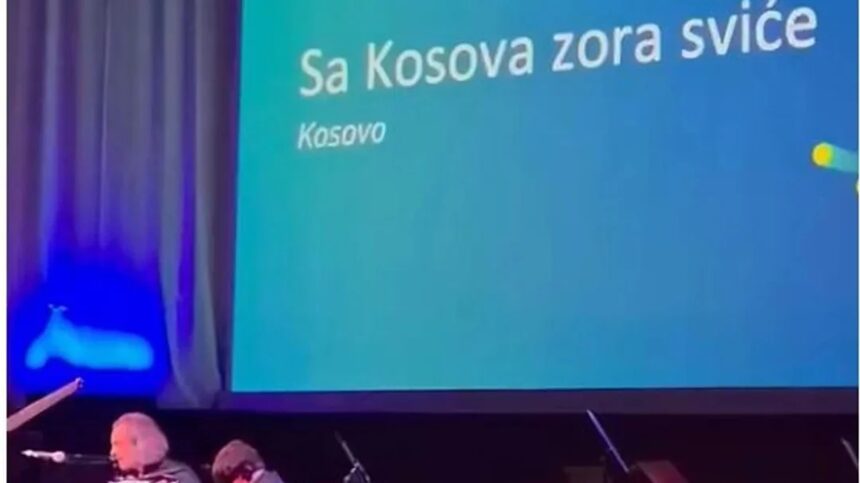
Kosovo has no representative at the event. However, one day before the main programme, the song “Oj Kosovo, Kosovo” was performed during the opening evening and concert.
The incident has sparked controversy, as an event dedicated to EU enlargement and bringing countries across the region closer to the European Union proceeded without Kosovo being represented, while a song associated with Serbian nationalist narratives portraying Kosovo as part of Serbia’s historical and national identity was performed on stage.
According to the official programme published for the event, the evening of 15 November was scheduled to feature performances by the Western Balkans Youth Orchestra, together with the Slovenian music group “Kapobanda.” It was precisely the Slovenian band “Kapobanda” that performed the Serbian song “Oj Kosovo, Kosovo.”
Meanwhile, the main programme on 16 November is scheduled to include speeches by European Commission President Ursula von der Leyen, Finnish President Alexander Stubb, and Enlargement Commissioner Marta Kos. However, what makes this event particularly sensitive for Kosovo is the content of the song that was performed.
“Sa Kosova zora sviće,” the opening line of the song, translates into English as “From Kosovo, the dawn is breaking.” The song is better known by its refrain, “Oj Kosovo, Kosovo,” and is one of the Serbian patriotic songs closely associated with Serbia’s historical and nationalist narrative surrounding Kosovo.
It was written in 1989 by Serbian composer and singer Ljubomir “Ljuba” Manasijević, during commemorations marking the 600th anniversary of the 1389 Battle of Kosovo.
The song was recorded in 1990 and later became particularly prominent within Serbian nationalist discourse concerning Kosovo. Its lyrics refer to Gračanica, Vidovdan, Prince Lazar and Miloš Obilić, figures of considerable importance in Serbian epic and religious tradition. However, its political message becomes more explicit in verses declaring Kosovo to be their land and insisting that they will never surrender it.
Another version of the song was released on 27 June 2022 by Serbian singer Danica Crnogorčević, in collaboration with the ethno group “Gorica,” ahead of Vidovdan. In her presentation of the song, she also included a message by Metropolitan Amfilohije, in which Kosovo was described as “the heart of the heart of the Serbian people” and as a place that Serbs could never abandon.
The European Commission-organised forum aims to discuss the future of EU enlargement, reforms, security and the European prospects of countries across the region.
Against this backdrop, the performance of a song carrying such messages about Kosovo raises questions about the political sensitivity involved in selecting the artistic repertoire for an event intended to promote cooperation, regional dialogue and the European integration of the Western Balkans.