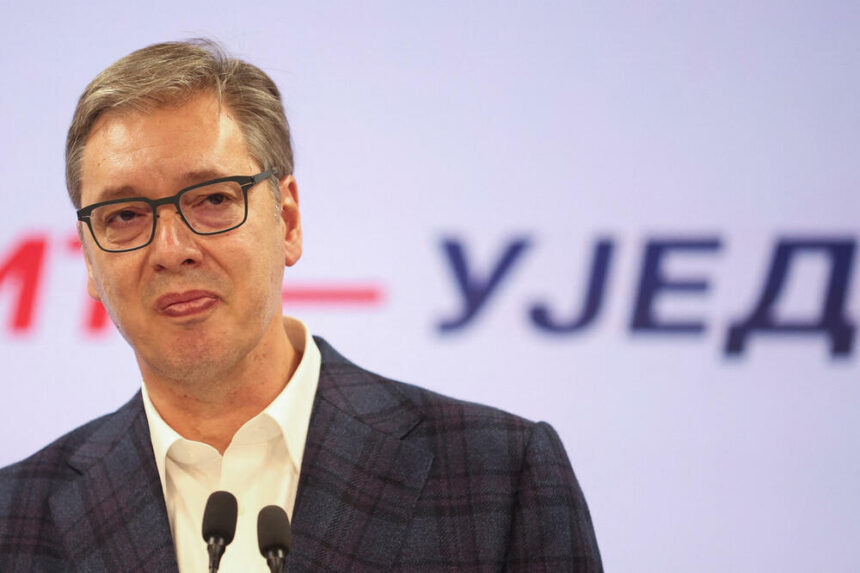
The European Union pressured Aleksandar Vučić to withdraw security forces from Belgrade’s Pionirski Park on election night, warning him against taking actions that could have triggered a civil war in Serbia, former Belgian ambassador to Belgrade Denis de Hauer has said.
In an interview with Serbian television channel Insajder, De Hauer said the EU was not merely observing developments in Serbia ahead of the October 25 parliamentary elections and on election day, when large numbers of security personnel were deployed around the presidential building and the Republic Electoral Commission, raising fears of potential clashes.
Asked whether Brussels would pay closer attention to Serbia once the government is formed by Studentska Lista, which secured a decisive electoral victory, De Hauer said the EU had already been actively involved before what she described as the fall of Vučić’s regime.
“You have certainly heard that it was thanks to the European Union that Vučić withdrew soldiers and police officers from Pionirski Park. The Union put pressure on him not to start something that could have ended in civil war,” she said.
De Hauer stressed that the EU was prepared to support Serbia during its political transition, arguing that the immediate priorities should be restoring the proper functioning of institutions, protecting the economy and maintaining political stability.
“This is not the time for revenge or settling scores with political opponents, but for working on institutional reforms. The European Union is there and ready to help,” she said.
The former ambassador, who served as Belgium’s representative in Belgrade from 2006 to 2011, expressed optimism about Serbia’s political future and praised the student movement for its courage, as well as citizens who supported it for their determination.
She described the movement as an example of how democracy remained alive in Serbia, praising its decentralised structure and the capabilities of its members.
EU accused of prioritising stability over democracy
De Hauer also addressed criticism that the European Commission had been too accommodating towards Vučić and the Serbian Progressive Party (SNS) during their years in power.
She acknowledged that Brussels had long prioritised regional stability over concerns about the state of democratic institutions in Serbia, arguing that the country’s importance made its stability essential for the wider Western Balkans.
According to De Hauer, Serbia accounts for approximately half of the region’s population and half of its gross domestic product, making its political and economic stability particularly significant.
However, she said the EU had increasingly faced criticism over its approach, with concerns about democratic backsliding eventually becoming more prominent within European institutions.
She also pointed to the close relationship between SNS and the European People’s Party (EPP), the largest political group in the European Parliament, which includes European Commission President Ursula von der Leyen’s political family.
De Hauer argued that SNS’s associated membership in the EPP helped protect Vučić from stronger European criticism.
She said Vučić had repeatedly used the prospect of limited reforms to ease pressure from Brussels, allowing the adoption of some legislative changes while ensuring that his broader political system remained intact.
According to her, he would present Serbia as making significant progress during visits to European institutions, only to return home and portray the EU as an unfair partner imposing conditions against Serbia’s interests.
“Of course, that was a lie. But it worked for some time, until the criticism became too strong,” she said.
De Hauer added that Serbia’s democratic institutions continued to deteriorate during this period and that the EU eventually stopped making concessions to Vučić, even withholding certain financial assistance.
Kosovo and Russia’s influence shaped Brussels’ approach
The former ambassador identified the Kosovo issue as one of the main reasons European institutions had continued engaging with Vučić despite concerns about his domestic policies.
She said the Serbian president had consistently presented himself as the only leader capable of reaching a binding agreement with Kosovo, encouraging Brussels to tolerate problems within Serbia in the hope of avoiding another regional crisis.
However, De Hauer argued that Vučić ultimately failed to resolve the dispute.
She also rejected claims that the EU requires Serbia to formally recognise Kosovo, pointing out that five EU member states still do not recognise Kosovo’s independence and that the bloc therefore has no unified position on the matter.
Another major consideration, she said, was Brussels’ concern that excessive pressure on Belgrade could push Serbia closer to Russia and China.
De Hauer argued that the EU had contributed far more to Serbia’s economy than either Moscow or Beijing, describing the bloc as Serbia’s largest investor, provider of financial assistance and economic partner.
She criticised Vučić for failing to communicate the scale of European support to Serbian citizens, saying that billboards and government messaging had frequently highlighted Russian and Chinese assistance while largely ignoring the EU’s contribution.
According to De Hauer, this contributed to declining public support for European integration and growing distrust towards Brussels.
Her remarks come amid a major political transition in Serbia following Studentska Lista’s victory in the October 25 elections.
The British newspaper The Times reported in late October, citing its sources, that Vučić had been prepared to use force to remain in power but abandoned the plan following discussions with representatives of European governments.