Serbia’s state-owned arms trading company, Jugoimport SDPR, generated hundreds of millions of euros in revenue in 2025 despite a months-long government embargo on weapons exports, raising questions about how the restrictions were implemented and who controlled the country’s arms trade.
Financial reports analysed by Radio Free Europe (RFE) show that Jugoimport SDPR recorded revenues exceeding €300 million last year, placing it among the five Serbian companies with the highest revenue growth.
The earnings came in a year when Serbia officially suspended the export of ammunition and weapons following instructions from then-President Aleksandar Vučić.
The moratorium was introduced in late June 2025, amid the Israeli-Iranian conflict and repeated accusations from Moscow that Serbian ammunition was reaching Ukraine through intermediaries. Exports officially resumed in February 2026.
However, Jugoimport SDPR told RFE that exports had never been completely suspended. Instead, the company said the government had introduced stricter procedures for obtaining export licences.
In addition to approvals from the Foreign Affairs, Interior and Defence ministries and the Security Intelligence Agency (BIA), exporters were required to obtain approval from the National Security Council, which was headed by Vučić at the time.
Military analyst Aleksandar Radić told RFE that the arrangement effectively created two categories of exporters: companies facing an official ban and those receiving individual approval to continue their operations.
“Actually, the decision was in Vučić’s hands. He unilaterally introduced the moratorium. And if Vučić said exports could go somewhere, then they went there. Everything else was under embargo,” Radić said.
The Serbian Progressive Party (SNS) did not respond to RFE’s questions about allegations that Vučić directly controlled the arms trade.
Hundreds of millions in export and import contracts
According to Jugoimport SDPR, the company signed 57 export contracts with 22 countries in 2025, worth a combined $643 million.
It also concluded 237 import contracts with 27 countries, valued at approximately $2.2 billion.
The company identified Cyprus, Azerbaijan and Israel among its key international clients but did not provide detailed information about the transactions or the specific equipment involved.
Financial reports indicate that approximately one-quarter of Jugoimport SDPR’s 2025 revenue came from exports, while three-quarters resulted from imports.
Around 90 percent of the company’s imports were intended for Serbia’s armed forces.
Jugoimport SDPR told RFE that its role in military procurement included administrative support, such as preparing contracts and processing payments, while decisions about what weapons to purchase and from which suppliers were made elsewhere.
The Defence Ministry declined to provide details about the purchases.
International reports have previously identified China as Serbia’s largest military supplier, with deliveries including ballistic missiles and air defence systems. Serbia has also acquired Israeli military equipment, including drones.
Growing military cooperation with Israel
Military cooperation between Serbia and Israel has expanded in recent years.
Serbia has imported Israeli drones, while ammunition deliveries to Israel reportedly accelerated after the outbreak of the Gaza war in October 2023.
Cooperation has also included plans for Jugoimport SDPR to work with a private Israeli company on drone production at a factory near Belgrade.
The company has not publicly disclosed the full details of the arrangement.
Radić questioned whether Serbia’s military procurement decisions were driven primarily by the operational needs of its armed forces, arguing that political considerations and confidential agreements played a significant role.
He described arms trading as one of the most important business and political instruments of the outgoing government, arguing that military equipment had also been used as a tool of foreign policy and that some contracts could involve potential corruption.
Students’ electoral winners promise investigation
The Studentska lista, which won the October 25 parliamentary elections, has announced plans to review Serbia’s arms trade agreements and investigate possible abuses.
The incoming government is expected to establish an independent commission to examine potential corruption and irregularities, with Jugoimport SDPR among the companies under scrutiny.
In a written response to RFE, representatives of the Studentska lista said decisions concerning individual companies would be discussed and communicated publicly once the new government takes office.
Jugoimport SDPR rejected allegations of corruption and political control by the SNS, describing them as “absolutely inaccurate”. The company added that, as a state-owned enterprise, it would follow the policies of the Serbian government.
Radić, however, warned that cancelling existing contracts could prove difficult, even if investigations uncover irregularities.
He argued that the new authorities could introduce stronger oversight and establish more transparent procedures, but that contracts already concluded might be impossible to reverse.
Lack of transparency over Serbia’s arms trade
One of the main concerns raised by RFE’s investigation is the lack of publicly available information about Serbia’s weapons exports and imports.
In previous years, the Serbian government published reports identifying the countries involved in arms trading, even though the precise quantities and composition of military equipment were classified.
Those reports have not been published in recent years, leaving the public with limited information about Serbia’s international arms transactions.
The disappearance of the reports coincided with Russia’s full-scale invasion of Ukraine in February 2022 and allegations that Serbian ammunition was reaching both sides of the conflict through intermediaries.
Belgrade has repeatedly insisted that it does not directly supply weapons to countries at war, maintaining that Serbia follows a policy of military neutrality. Vučić has also argued that Serbia cannot control the final destination of equipment legally sold on international markets.
In 2025, Russia’s Foreign Intelligence Service (SVR) accused Serbia of supplying ammunition to Ukraine through intermediaries, naming several Serbian state-owned companies, including Jugoimport SDPR.
The Russian agency claimed that Serbian companies had supplied Ukraine with 100,000 artillery shells and one million rounds of ammunition for automatic weapons. The allegations have not been independently established in full.
Jugoimport’s business network and banking connections
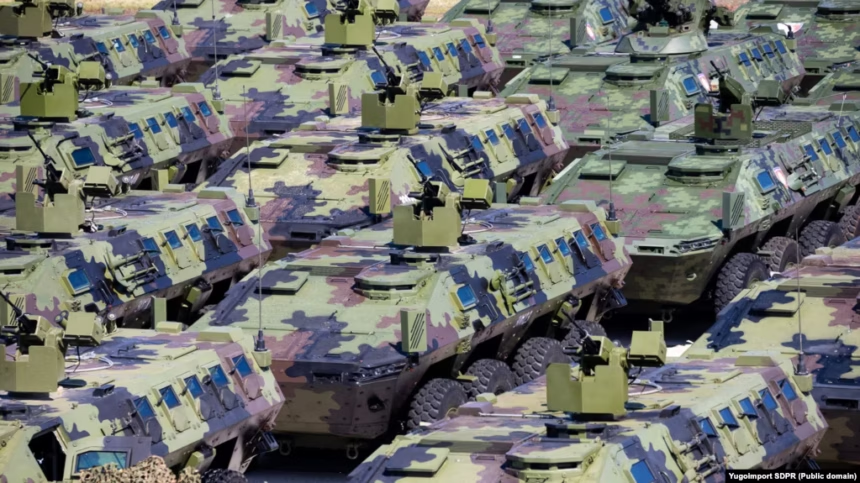
Jugoimport SDPR is one of the largest defence industry companies in the region. Beyond arms trading, it is involved in weapons production, the development of combat systems and the promotion of Serbian military equipment on international markets.
The company operates through approximately ten subsidiaries located in Belgrade, Ada, Valjevo, Požega and Kuršumlija. It also holds a 23 percent minority stake in Srpska Banka, while the Serbian government is the bank’s majority shareholder.
RFE also examined the company’s financial connections with Alta Banka, which entered bankruptcy proceedings in late October.
According to the National Bank of Serbia’s register, Jugoimport SDPR held three accounts at the bank, including one dinar account and two foreign-currency accounts.
The company said that less than €50,000 remained in its accounts, an amount covered by deposit insurance, and maintained that its operations had not been affected.
Two of its subsidiaries also held accounts at Alta Banka.
The investigation further identified hundreds of registered bills of exchange listing Jugoimport SDPR as a debtor. More than 40 were registered between February and October 2026.
The company explained that Alta Banka had acted only as a technical intermediary for registering the bills with the National Bank of Serbia. However, it did not clarify who the beneficiaries were or what financial obligations the instruments secured.
Millions spent on public procurement
Although major weapons contracts are generally handled confidentially and through direct negotiations, Jugoimport SDPR also conducts public procurement for other goods and services.
Since the beginning of 2026, the company has spent nearly €8 million through public procurement procedures covering everything from software and office supplies to fuel, vehicles, equipment and work clothing.
One of its largest ongoing tenders is worth approximately €5 million and concerns airline tickets and hotel accommodation over the next three years.
The previous three-year contract for the same services was valued at around €1.5 million.
Jugoimport SDPR maintains that its public procurement procedures are transparent and comply with the law, with contracts awarded to the most favourable bidders.
However, RFE’s analysis of procurement decisions during 2026 found that the company frequently received only one bid in its tender procedures, raising questions about competition and the transparency of the process.
The investigation adds to growing scrutiny of Serbia’s defence industry as the incoming political authorities prepare to examine arms contracts, procurement practices and the role of state-owned companies during Vučić’s time in power.