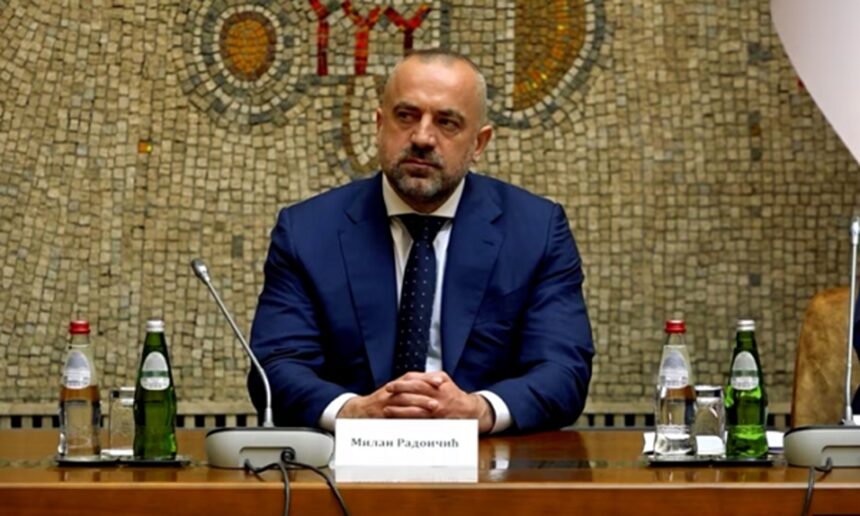
Milan Radoičić, the man who openly admitted leading the terrorist attack in Banjska, is once again at the centre of troubling questions about Serbia’s willingness to hold him accountable. He was reportedly absent from the Savski Venac police station on November 15, despite being legally required to report there twice a month.
According to the Balkan Investigative Reporting Network (BIRN), which published the report on November 17 citing its own sources, Radoičić failed to fulfil his latest reporting obligation.
And what is Serbia’s response? Silence.
The Higher Court in Belgrade refused to confirm whether Radoičić had appeared at the police station. In a response to Radio Free Europe (RFE/RL), the court said it would not disclose information received from the police, referring instead to its previous statement that it was supervising compliance with the measure.
That is not an answer. It is an institution avoiding the most basic question: Did the man who claimed responsibility for the Banjska attack report to the police, or has he disappeared while Serbian authorities refuse to say so?
RFE/RL also tried to reach his lawyer, Goran Petronijević, but he did not respond to calls or messages.
Radoičić is wanted by INTERPOL over his alleged role in organising the armed attack in Banjska and remains under investigation by Serbia’s Higher Public Prosecutor’s Office. In Kosovo, prosecutors have charged 45 people over the attack in which Police Sergeant Afrim Bunjaku was killed. Three defendants have been convicted, while the others, including Radoičić, remain at large.
At the time of the attack, Radoičić was deputy leader of the Serbian List, a party that has operated with the backing of Serbia’s ruling Serbian Progressive Party and Aleksandar Vučić. His political connections and position in Serbia make the continued lack of clear answers even more serious.
Since October 2023, he has been required to report to the police on the 1st and 15th of every month. His passport was confiscated, and the Higher Court previously claimed he had complied with the measure. Yet unofficial reports that emerged on November 13 suggested he had fled to Russia.
Radoičić is also under US and UK sanctions over allegations of organised crime and corruption.
His last known public appearance was at an election rally of Vučić’s Serbian Progressive Party in Kragujevac.
And the questions do not end with Radoičić. Zvonko Veselinović, a businessman from northern Kosovo and a former associate of Radoičić, has also reportedly left Serbia. According to security sources in Bosnia and Herzegovina cited by RFE/RL, he flew from Sarajevo to Turkey on November 11 using a Serbian passport. His brother, Žarko Veselinović, accompanied him. Both brothers are also under US sanctions over allegations of organised crime and corruption.
Serbia cannot keep presenting itself as a state governed by the rule of law while a man who admitted leading the Banjska attack remains beyond the reach of justice in Kosovo, and its own institutions refuse to provide clear answers about his whereabouts and compliance with court orders. A court order is not a formality. INTERPOL notices are not decoration. And accountability cannot be replaced with carefully worded statements.
**Belgrade must answer: where is Milan Radoičić, who is protecting him, and why has Serbia still failed to bring him to justice? Kosovo deserves answers. Afrim Bunjaku’s family deserves justice. The international community must stop treating Serbia’s silence as an acceptable response.