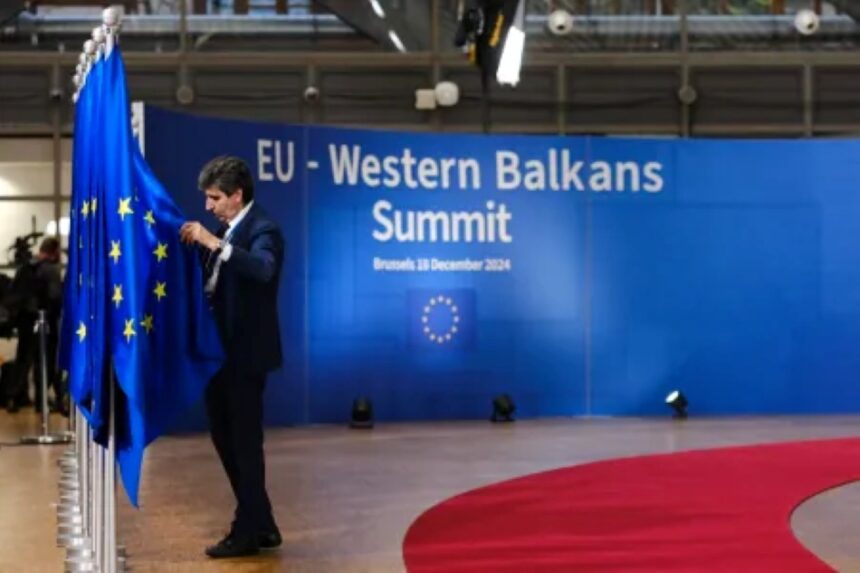
The European Union is expected to adopt a tougher stance on the Kosovo-Serbia dialogue and the implementation of previously reached agreements at its upcoming summit with Western Balkan leaders on November 25.
The EU will host leaders from the six Western Balkan countries – Albania, Bosnia and Herzegovina, Kosovo, Montenegro, North Macedonia and Serbia – all of which remain officially committed to joining the European bloc.
Although these summits are held twice a year and rarely generate major political developments, the previous two meetings, held in Brussels in December 2025 and Montenegro in June this year, were marked by considerable political tensions, particularly involving then-Serbian President Aleksandar Vučić, who frequently adopted a confrontational approach.
However, following Vučić’s departure from power after the October 25 parliamentary elections, won by the student movement, the upcoming summit will represent the first major test of whether the EU can bring the region’s aspiring members closer to eventual accession.
The student movement, which has yet to establish a clearly defined leadership and brings together a politically diverse group, is now facing expectations from Brussels regarding Serbia’s future foreign policy and its approach to regional relations.
A preliminary draft of the declaration expected to be signed at the end of the summit, obtained by Radio Free Europe/Radio Liberty (RFE/RL), suggests that Brussels is seeking to adopt a firmer position and deliver clearer messages to the region’s leaders, including Serbia’s potential new government if it is formed before the meeting.
According to RFE/RL, the latest draft contains stronger language on both the Kosovo-Serbia dialogue and other key political issues, sending a direct message to the incoming leadership associated with the student movement.
During the election campaign and following its victory, the movement expressed considerable reservations about the need for high-level political dialogue with Kosovo, as well as Serbia’s close relationship with the Kremlin.
The reference to the Kosovo-Serbia dialogue occupies a significantly more prominent place in the draft declaration than in previous years and is accompanied by a stronger sense of political urgency.
The proposed text states that the failure to normalise relations between Prishtina and Belgrade continues to hinder both sides on their paths towards European integration.
It also emphasises that all agreements reached within the EU-facilitated Belgrade-Prishtina dialogue must be implemented.
At the previous summit, Serbia, under Vučić’s leadership, refused to support language calling on Western Balkan countries to align with EU sanctions against Russia. Belgrade also opposed proposed conditions linked to the Kosovo-Serbia dialogue.
The upcoming meeting will therefore provide an important indication of whether Serbia’s political transition will lead to a change in its approach towards Kosovo, European integration and its relations with Russia.