Serbia’s Student List, which won the parliamentary elections, has responded to Kosovo’s draft law on the Central Inspectorate of Cultural Heritage with language that exposes the continuity of Belgrade’s political approach towards Kosovo, referring to the country as a “so-called state” and questioning the legitimacy of its institutions.
The student list issued a statement after Kosovo’s Assembly approved the draft legislation in its first reading, claiming that the proposed inspection powers could undermine the protection of Serbian Orthodox churches and monasteries.
It also criticised the fact that the Serbian Orthodox Church had not been consulted and called on international representatives to monitor the legislative process. The movement further demanded that the proposed law comply with the Law on Special Protective Zones, invoking the guarantees established under the Ahtisaari Plan.
Yet its choice of language is particularly revealing. Rather than addressing Kosovo as an independent state with its own constitutional institutions, the movement deliberately adopted Belgrade’s familiar terminology, describing it as a “so-called state”. This is not simply a disagreement over cultural heritage legislation; it is a political position that continues to deny Kosovo’s statehood.
The protection of Serbian Orthodox religious sites is already regulated by Kosovo’s legal framework, including specific safeguards under the Law on Special Protective Zones. But the Student Movement’s statement goes further, portraying Kosovo’s exercise of its own legislative authority as a matter requiring scrutiny from Belgrade and international representatives.
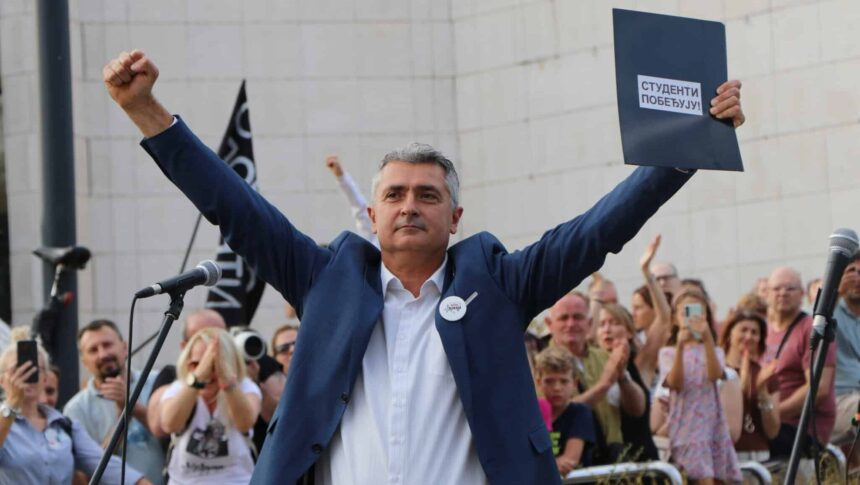
For a “movement” that has presented itself as a new political force and an alternative to Aleksandar Vučić’s establishment, the rhetoric is strikingly familiar. Its leaders may be different, but when it comes to Kosovo, the message remains unchanged: question its sovereignty, undermine its institutions and refuse to recognise the reality of its independence.
The statement offers little indication that Serbia’s emerging political leadership intends to break with the nationalist positions that have shaped Belgrade’s policy towards Kosovo for years. A new generation of politicians appears to be carrying forward an old political agenda.