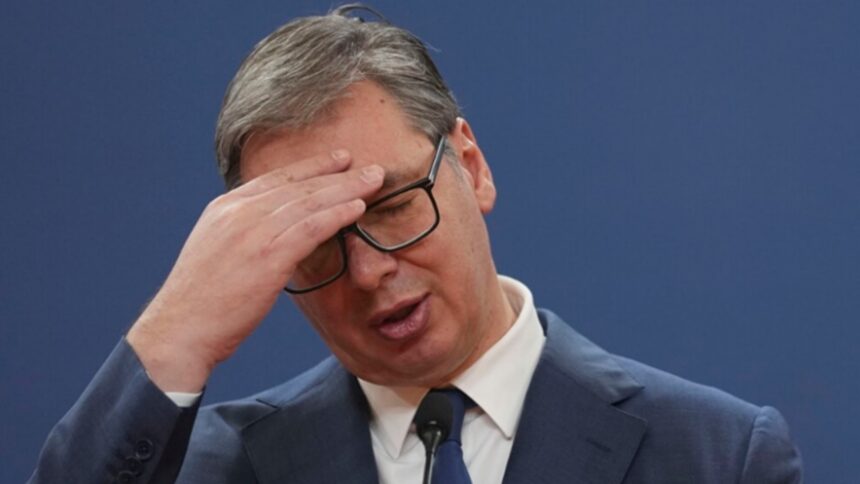
Former Serbian President Aleksandar Vučić has entered a new political role following his party’s electoral defeat, but his rhetoric towards political opponents appears largely unchanged, according to an analysis published by Serbian outlet Radar.
In an article titled “Democracy Is When You See Their Back”, journalist Miloš Čolić examines Vučić’s behaviour during the first days of the newly constituted Serbian parliament, arguing that the former president continues to demonstrate hostility towards the opposition, particularly representatives of the Students’ List, whose electoral victory dealt a major blow to the ruling Serbian Progressive Party (SNS).
The article points to the irony of SNS officials repeatedly discussing democracy and democratic principles in parliament despite having governed Serbia for 14 years. Čolić recalls a famous statement by Serbian writer Borislav Pekić: “Democracy is when you see their back”, suggesting that a genuine democratic transition requires those in power to eventually leave office.
Following the October elections, Vučić acknowledged his electoral defeat, a move SNS officials Ana Brnabić and Vladimir Đukanović described as a “gentlemanly” gesture. Vučić himself later praised his handling of the defeat in an interview with Swiss publication Weltwoche.
However, Čolić argues that the former president’s subsequent statements reveal little willingness to accept political responsibility or engage constructively with his opponents.
During his parliamentary appearances, Vučić reportedly described the prospect of an expert-led government using insulting language, while continuing to portray political opponents as enemies. He also promised to fight what he called a political evil, accusing unnamed forces, including the so-called “deep state” in the United States, of contributing to his party’s defeat.
The article highlights the scale of the hostility directed not only at the elected representatives of the Students’ List but also at the millions of citizens who supported them. Čolić notes that Vučić has repeatedly used labels such as “Ustaše”, “terrorists” and “foreign mercenaries” when referring to his opponents.
The Students’ List received 2,354,417 votes, according to the figures cited in the article, securing 623,094 more votes than the SNS-led coalition.
Čolić also recalls remarks by controversial nationalist politician Vojislav Šešelj, who sought to discredit members of the Students’ List by making claims about their alleged psychiatric hospitalisation.
Drawing on Nelson Mandela’s reflections on hatred and revenge, the journalist argues that the continued use of inflammatory rhetoric risks deepening political divisions rather than helping Serbia move towards reconciliation.
The central focus of the analysis, however, is Vučić’s transition from the presidency to parliament. Although he no longer holds the country’s highest office, his parliamentary position gives him another public platform from which to address the nation and confront political opponents.
According to Čolić, the former president may have lost the institutional platform that allowed him to dominate daily political coverage, but parliament still provides him with an opportunity to maintain his political influence and public visibility.
The article concludes that Vučić’s departure from the presidency does not necessarily signal an end to the political confrontations that characterised his time in power. His new role in parliament could instead become another stage for continuing the same rhetoric and political battles.