
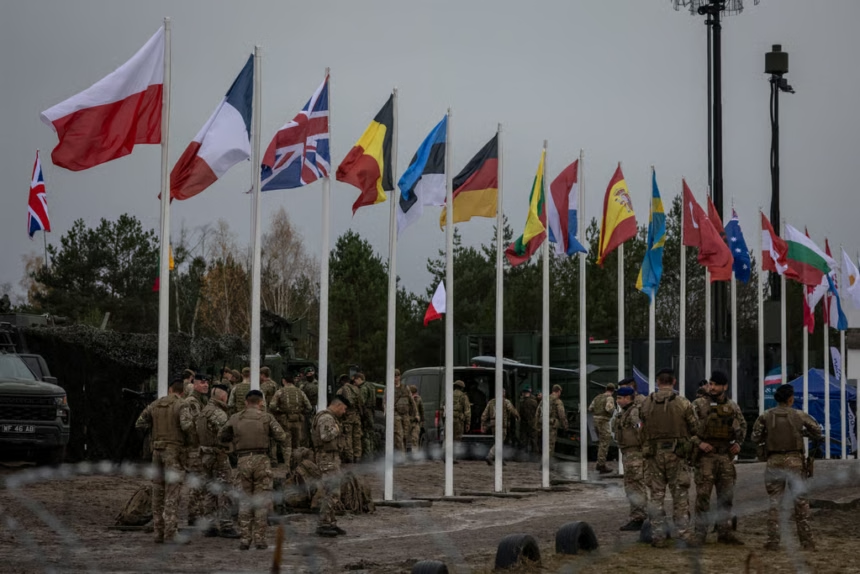
Europe is facing growing pressure from both Washington and Moscow to reconsider its security architecture as diplomatic efforts to end Russia’s war in Ukraine intensify. However, any changes could have far-reaching consequences for NATO, the European Union and Ukraine’s future security.
In an analysis published on Tuesday, POLITICO outlines five possible scenarios for how Europe’s security arrangements could evolve, ranging from increased dialogue with Russia to maintaining the current system.
The debate has gained momentum following comments by US President Donald Trump’s peace envoy, Jared Kushner, who argued that security guarantees for Ukraine cannot be negotiated separately from the broader European security framework.
Russian President Vladimir Putin has long demanded changes to Europe’s security arrangements, including a reduction of NATO’s military presence and a greater role for Moscow in decisions affecting the continent.
However, European officials have stressed that Ukraine and European countries must not be excluded from discussions about their own security.
1. Strengthening the OSCE
One possibility is to give the Organization for Security and Co-operation in Europe (OSCE) a greater role in monitoring a potential ceasefire, facilitating negotiations and reducing military tensions.
The organization, which includes both Russia and Western countries, could provide an existing platform for rebuilding communication and transparency.
Its Vienna Document already contains mechanisms requiring countries to provide advance notification of certain large-scale military exercises.
However, the OSCE’s 57-member structure and consensus-based decision-making could make it difficult to respond quickly.
POLITICO likelihood assessment: 3/5.
2. Reviving the NATO-Russia Council
Another scenario involves bringing back the NATO-Russia Council, established in 2002 as a platform for dialogue, cooperation and managing security risks.
The council has been inactive since shortly before Russia launched its full-scale invasion of Ukraine in February 2022.
Trump’s peace envoy Jared Kushner has expressed support for reviving the format.
Some NATO diplomats believe renewed discussions could help prevent military escalation after a potential peace agreement. However, they warn that restoring the council could also give Moscow greater political legitimacy without necessarily changing its behaviour.
POLITICO likelihood assessment: 2/5.
3. Negotiating a new European security treaty
A more ambitious possibility would be to negotiate a new Europe-wide security agreement that reflects changes in the continent’s geopolitical landscape.
Such an agreement could account for Finland and Sweden joining NATO, Ukraine’s aspirations for EU membership and emerging military threats, including artificial intelligence.
However, the proposal faces considerable resistance, particularly because European governments fear that a new treaty could give Russia influence over decisions that should remain within the authority of sovereign states and existing alliances.
Germany has already rejected discussions that would question existing alliances.
Russia has also proposed bilateral non-aggression agreements with individual NATO members, an idea viewed by alliance diplomats as an attempt to divide Western countries.
Ukraine, meanwhile, is seeking clear and enforceable security guarantees rather than general political commitments.
POLITICO likelihood assessment: 1/5.
4. Establishing a new EU-Russia dialogue format
The European Union could also consider restoring a formal channel of communication with Moscow, similar to the partnership arrangements that existed before relations deteriorated following Russia’s annexation of Crimea in 2014.
Such a framework could cover sanctions, trade, visas, border management and eventually aspects of post-war cooperation.
However, European diplomats argue that any renewed engagement must not undermine the existing security architecture or lead to a premature normalization of relations.
Experts also warn against quickly restoring energy dependence on Russia, particularly through renewed natural gas imports.
Brussels maintains that meaningful discussions on Europe’s security must involve NATO allies and EU member states and should follow a ceasefire in Ukraine.
POLITICO likelihood assessment: 2/5.
5. Maintaining the existing security architecture
The fifth and, according to officials consulted by POLITICO, most likely scenario is that Europe’s current security arrangements remain largely unchanged.
This would mean preserving NATO and the EU as the central pillars of European security, without granting Russia a role in determining their policies or decisions.
Experts argue that Russia is not a member of either organization and that there is no realistic way to create a system in which Moscow and European countries jointly determine the continent’s security arrangements.
Although this outcome could leave tensions unresolved, European officials believe Russia’s demands make a broader agreement difficult to achieve.
One NATO diplomat also questioned the possibility of rebuilding trust with Moscow, arguing that Russia has repeatedly disregarded agreements reached over the past three decades.
POLITICO likelihood assessment: The most likely scenario.
Ultimately, the debate highlights a fundamental disagreement over Europe’s future security: Moscow wants greater influence over the continent’s military and political arrangements, while European governments insist that existing alliances and national sovereignty must be respected.
For Ukraine, the central question remains whether any peace agreement will provide credible guarantees against another Russian attack without compromising its right to determine its own future.