While Montenegro aims to conclude its European Union accession negotiations by the end of this year and Albania hopes to achieve the same goal in 2027, Kosovo continues to lag behind in the European integration process. Nearly four years after submitting its membership application, Kosovo’s request has yet to be referred to the European Commission for assessment.
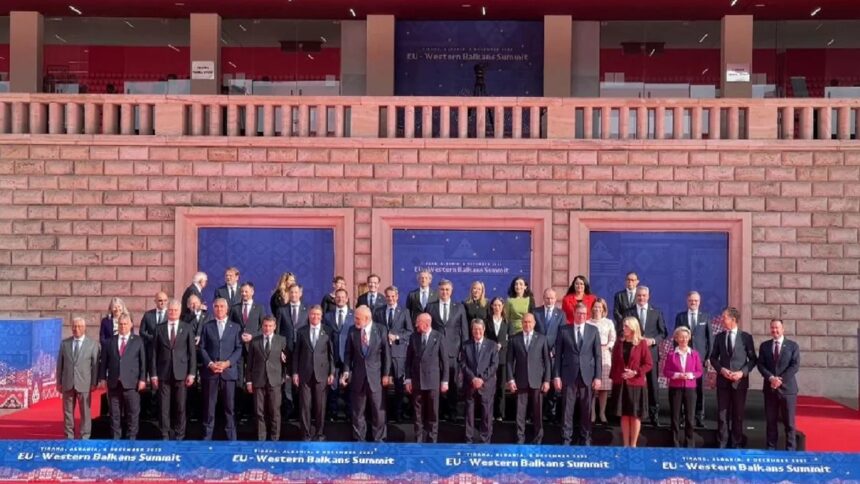
This gap between Western Balkan countries is expected to be one of the issues surrounding the EU–Western Balkans Summit, scheduled to take place in Brussels on Wednesday, November 25.
For Kosovo, the summit is once again expected to reaffirm the message that the region’s future lies within the European Union.
“The future of the Western Balkans is in the European Union,” European Council President Antonio Costa has stated.
Despite this shared commitment to the region, Kosovo continues to face the most difficult position on the path towards European integration. It remains the only Western Balkan country that has not been granted EU candidate status.
The difference compared with other countries in the region is significant. Montenegro has opened all 33 negotiating chapters, provisionally closing 25. Albania has also opened 33 chapters and provisionally closed four, while Serbia has opened 22 and provisionally closed two.
North Macedonia formally launched accession negotiations in 2022, while Bosnia and Herzegovina, despite its internal political challenges, was granted candidate status in December of the same year.
Kosovo, meanwhile, continues to be classified by Brussels as a “potential candidate”.
One of the main obstacles is that five EU member states – Spain, Greece, Cyprus, Romania and Slovakia – do not recognise Kosovo’s independence. Formal progress in the process requires the agreement of all member states.
In its report published on November 4, the European Commission reiterated its readiness to prepare an opinion on Kosovo’s membership application if requested to do so by the Council of the EU. However, no such request has been made so far.
What Can Kosovo Gain from the Summit?
EU–Western Balkans summits generally serve as a platform for political messages, reaffirming commitments to economic cooperation and gradual integration, while urging countries in the region to accelerate reforms.
One of the main topics is expected to be the Growth Plan for the Western Balkans, worth €6 billion. Under the plan, Kosovo has been allocated up to €882.6 million.
However, access to these funds is conditional on implementing the agreed reforms and engaging constructively in the dialogue with Serbia.
Kosovo can benefit economically and make progress towards gradual integration into the European market even without obtaining candidate status. However, the official announcement for the summit does not mention any specific decision on advancing Kosovo’s status.
At the same time, the European Union continues to call on Kosovo to ensure functioning institutions, an independent judiciary, fight corruption, uphold fundamental rights and implement economic reforms.
“Where reforms stall, progress stalls,” EU Ambassador to Kosovo Dirk Schuebel has stated.
Dialogue with Serbia: Another Obstacle for Kosovo
In addition to domestic reforms, Kosovo faces another major condition on its path towards EU integration: the normalisation of relations with Serbia.
The Brussels Agreement and the Ohrid Implementation Annex, reached in 2023, have made commitments arising from the dialogue part of the European integration process.
Failure to implement these agreements could have direct negative consequences for Kosovo’s accession process and its access to EU financial assistance.
One of the main outstanding issues remains the establishment of the Association of Serb-Majority Municipalities.
Brussels is increasingly linking Kosovo’s European prospects to how non-majority communities are treated in the country.
In this regard, the EU has repeatedly criticised the closure of institutions supported by Serbia, the lack of coordination and the consequences these actions have for citizens who rely on services provided by those institutions.
The EU has also called for consultations with the Serb community on matters relating to education, healthcare and other public services.
Serbia, meanwhile, has faced criticism from the European Union for obstructing Kosovo’s membership in international organisations and failing to ensure accountability for the attack in Banjska.
Kosovo has had a Stabilisation and Association Agreement in force since 2016, while visa liberalisation took effect in January 2024.
Despite these steps towards closer ties with the EU, however, the accession process remains stalled.
The review of Kosovo’s membership application, which should be the next step, still has no set timetable.