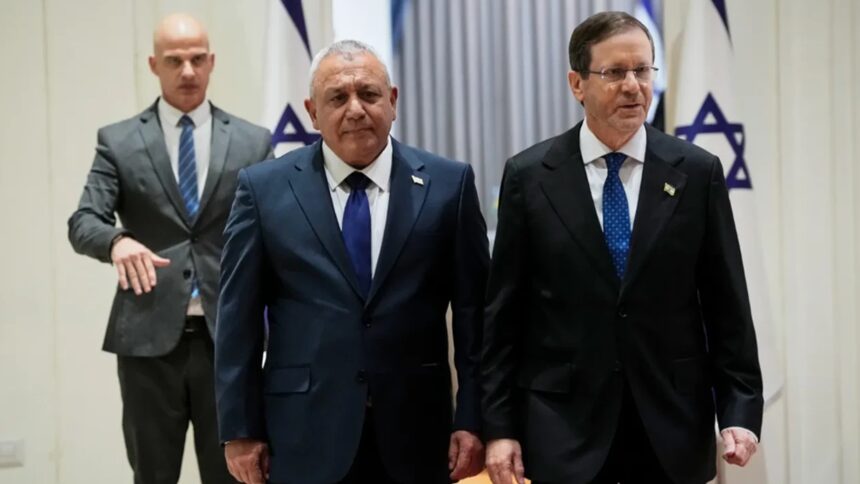
Israeli prime ministerial candidate Gadi Eisenkot plans to inform President Isaac Herzog next week whether he has succeeded in forming a government, the news outlet Walla reported on Tuesday.
According to Walla, Eisenkot, leader of the Yashar party, aims to conclude negotiations with Prime Minister Benjamin Netanyahu’s Likud party and the ultra-Orthodox parties by the end of this week.
If the talks fail, he plans to move forward with a government supported externally by Arab parties, without requesting an extension to his mandate, the report said.
Eisenkot has not commented on the report.
His initial 28-day mandate to form a government expires on 6 December and can be extended by a further 14 days.
Under Israel’s Basic Law, the president’s announcement that a government has been formed does not automatically mean that it takes office.
Vote of Confidence
The proposed cabinet, its programme and the allocation of ministerial portfolios must be presented to the Knesset for a vote of confidence. The vote must take place within seven days of parliament being notified that a government has been formed.
Walla reports that Eisenkot is determined to remove Netanyahu from power and proceed with forming a government, even if negotiations with Likud and the ultra-Orthodox parties fail.
According to the outlet, the delay in announcing a government is largely linked to Eisenkot’s efforts to accommodate the demands of two key political partners.
Former Prime Minister Naftali Bennett insists that all possibilities for forming a national unity government with Likud must first be exhausted, while Yisrael Beiteinu leader Avigdor Lieberman wants to explore the possibility of including ultra-Orthodox parties in the coalition.
“Eisenkot’s camp intends to conclude negotiations on both fronts by the end of this week, with the aim of informing the president – possibly early next week – that he has succeeded in forming a government,” Walla reported.
Minority Government
The timeline could shift by a day or two, but this is the current course being pursued by Eisenkot’s Change Bloc, which has decided not to prolong negotiations unnecessarily or request an extension from Herzog, the outlet added.
If negotiations with Likud and the ultra-Orthodox parties fail, Eisenkot intends to form a minority government comprising the parties in the Change Bloc and rely on external support from Arab parties in the Knesset confidence vote, Walla reported.
The Change Bloc consists of Eisenkot’s Yashar party, Bennett’s Together party, Lieberman’s Yisrael Beiteinu and the Democrats, led by Yair Golan. Together, the four parties hold 48 seats in the 120-member Knesset.
The Joint List and the United Arab List, also known as Ra’am, hold a combined 19 seats. Their support would therefore give an Eisenkot-led government backing from 67 lawmakers.
Arab Support Without Joining the Coalition
Regarding Eisenkot’s campaign promise not to rely on Arab parties, Walla reported that he would consider himself to have honoured that commitment as long as those parties did not become coalition partners or members of the government itself.
“If Arab members of the Knesset choose to vote in favour of forming this government, Eisenkot will make clear that this is solely their decision,” the outlet reported.
Arab parties in Israel’s Knesset are signalling their willingness to support Gadi Eisenkot in replacing Benjamin Netanyahu, potentially allowing him to form a minority government without bringing them into the coalition.
The Joint List has indicated that it would help bring down Netanyahu’s government, while Ra’am leader Mansour Abbas has expressed confidence that differences can be overcome to form a stable government.
Although Arab parties do not regard an Eisenkot-led government as their preferred option, they consider it preferable to another Netanyahu government or fresh elections that could prolong his tenure as caretaker prime minister, Walla reported.