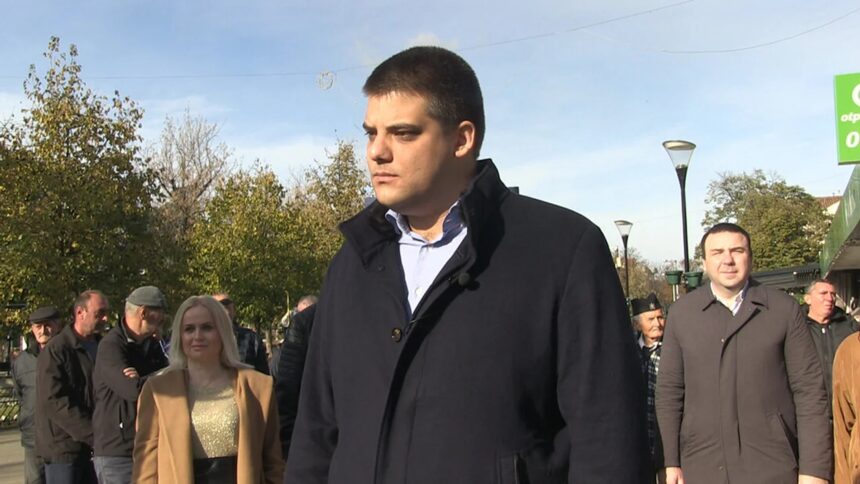
Aleksandar Šešelj, the son of Serbian politician Vojislav Šešelj, who was convicted by the Hague Tribunal of crimes against humanity, has been appointed to the Serbian Parliament’s delegation to the Serbia–Republika Srpska Parliamentary Forum.
The decision on the composition of the delegation was adopted by the Serbian Parliament on 25 November 2026. The official document was signed by the Speaker of the Serbian Parliament, Aleksandar Čupić.
Aleksandar Šešelj’s name appears last on the list of 11 members appointed to represent the Serbian Parliament at this joint forum with the Republika Srpska entity in Bosnia and Herzegovina.
His inclusion in the delegation has sparked reactions on social media, largely due to his family name and the political legacy of the Šešelj family.
Jovan Golubović commented on the appointment in a Facebook post, expressing irony over the inclusion of the son of a man convicted of war crimes in a parliamentary delegation.
“Hahahaha… THE SON OF A MAN CONVICTED OF WAR CRIMES, ŠEŠELJ, IS A MEMBER OF THE DELEGATION??? … But the even greater tragedy is that the document was signed by the Speaker of the Russian Parliament — sorry, the Serbian Parliament!” Golubović wrote.
Who Is Vojislav Šešelj?
Vojislav Šešelj is the founder and longtime leader of the Serbian Radical Party (SRS), and one of the most prominent figures of Serbian nationalism during the breakup of Yugoslavia and the wars of the 1990s.
He was among the most outspoken supporters of the so-called “Greater Serbia” project, a political ideology that sought to incorporate territories inhabited by Serbs into a single state.
Šešelj was prosecuted by the International Criminal Tribunal for the former Yugoslavia (ICTY) in The Hague for crimes committed during the wars in the former Yugoslavia.
In 2016, the ICTY Trial Chamber acquitted him of the charges. However, on 11 April 2018, the Appeals Chamber of the International Residual Mechanism for Criminal Tribunals partially overturned the decision and sentenced him to ten years in prison for instigating the deportation, persecution and other inhumane acts as crimes against humanity.
The conviction was related to a speech he delivered on 6 May 1992 in Hrtkovci, Vojvodina, during which he called for the expulsion of the non-Serb population. The time he had already spent in detention was credited towards his sentence, which was consequently considered served.
Šešelj was one of the leading figures of Serbian ultranationalist politics and has for years supported territorial claims against neighbouring countries, including Kosovo.
His Son Continues the Politics of the Serbian Radical Party
Aleksandar Šešelj, born in 1993, serves as vice-president of the Serbian Radical Party and is a member of the Serbian Parliament.
He secured his parliamentary mandate through the electoral list led by Aleksandar Vučić, titled “Aleksandar Vučić – United Serbia”. In the current parliamentary composition, he is part of the parliamentary group associated with that list.
Despite obtaining his mandate through Vučić’s electoral list, he continues to hold the position of vice-president of the party founded and led by his father.
His positions on Kosovo have also followed the political line of the Serbian Radical Party.
In July 2026, Aleksandar Šešelj declared that Kosovo was a territory under NATO occupation and claimed that institutions in Pristina operated with the support of Western powers.
During a television appearance, he accused Prime Minister Albin Kurti of what he described as the “continuous persecution of the Serbian people in Kosovo”.
“ Kosovo and Metohija is a territory under occupation, primarily by NATO, but also by the separatist structures installed there,” Šešelj declared.
These statements reflect the continuation of the Serbian Radical Party’s political positions, as the party does not recognise Kosovo’s independence and continues to regard it as part of Serbia.
The Parliamentary Forum Linking Belgrade and Banja Luka
The Serbia–Republika Srpska Parliamentary Forum is a cooperation mechanism between the Serbian Parliament and the Assembly of the Republika Srpska entity in Bosnia and Herzegovina.
It was established under a memorandum signed on 20 September 2023 and consists of delegations of 11 members from each of the two parliaments.
The mechanism aims to strengthen institutional and parliamentary cooperation between Belgrade and Banja Luka within the framework of the special relations between Serbia and Republika Srpska.
Aleksandar Šešelj’s inclusion in the delegation places a representative of the Serbian Radical Party within an important mechanism of political cooperation between Serbia and the Serb entity in Bosnia and Herzegovina.
This comes at a time when Belgrade’s policies towards Kosovo and Bosnia and Herzegovina remain among the key issues of regional debate, particularly in relation to territorial claims, the concept of the “Serbian World”, and the continued positions of Serbian politicians who refuse to recognise Kosovo’s independence.