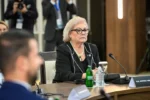
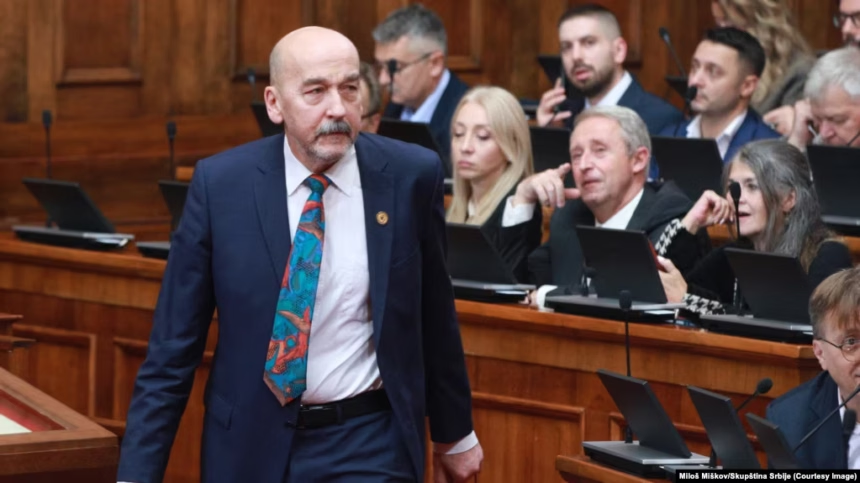
Radomir Saičić, a prominent academic and member of the Serbian Academy of Sciences and Arts (SANU), has been nominated by the Student List as its candidate in Serbia’s presidential election scheduled for December 27.
Saičić is a full professor at the University of Belgrade’s Faculty of Chemistry and has become one of the public figures associated with the student movement, which emerged from anti-corruption protests and demands for systemic political change.
The protests began following the November 1, 2024, collapse of the railway station canopy in Novi Sad, which killed 16 people. Over time, the demonstrations developed into a nationwide movement challenging corruption, institutional accountability and the political establishment.
Following the October 25, 2026, snap parliamentary elections, the student movement emerged as Serbia’s leading political force, ending the Serbian Progressive Party’s (SNS) 14-year rule under Aleksandar Vučić.
Saičić was among the first figures to publicly announce the student movement’s victory on election night.
“This victory is nobody’s personal trophy; it belongs to all of us. But dear Serbia, a great victory brings great responsibility,” he said on October 25.
He also declared that no force could permanently defeat a people determined to take their future into their own hands.
Political engagement and positions
Saičić was among the founders of the citizens’ group that formally submitted the Student List for the parliamentary elections. He subsequently secured a seat in Serbia’s National Assembly and was appointed to the parliamentary Committee on Education.
In June 2025, he signed a petition supported by several SANU members calling for the resignation of then-President Aleksandar Vučić. The petition accused Vučić of undermining Serbia’s democratic, institutional and social foundations.
In an interview with the weekly NIN at the time, Saičić argued that academics should not remain on the sidelines when society is facing a serious crisis.
His political positions also include support for maintaining productive relations with Russia and the claim that Kosovo is an integral part of Serbia, a position consistent with Belgrade’s refusal to recognise Kosovo’s independence, declared in 2008.
In the days following the parliamentary elections, Saičić said the Student List was not seeking political retaliation outside institutional frameworks but wanted to establish a new system in which justice and the law would apply equally to everyone.
He has outlined several priorities, including reforming the judiciary and media, ensuring more effective investigations and prosecutions over the Novi Sad railway station disaster, publishing previously undisclosed contracts related to major infrastructure projects and confiscating illegally acquired assets.
His nomination places an established academic at the forefront of the student movement’s political ambitions as it prepares for the presidential contest.
Academic career and education
Born in Belgrade in 1961, Saičić studied chemistry at the University of Belgrade’s Faculty of Sciences before completing his doctoral studies at the Faculty of Chemistry.
In 1987, he received Belgrade’s October Award for Students for his outstanding master’s thesis.
He continued his scientific training in France at the Institute of Chemistry of Natural Substances, part of the National Centre for Scientific Research (CNRS) in Gif-sur-Yvette.
His research focuses on organic chemistry, organic synthesis and medicinal chemistry.
Saičić became a full professor at the University of Belgrade’s Faculty of Chemistry in 2012. That same year, he was elected a corresponding member of the Serbian Academy of Sciences and Arts, becoming a full member in 2018.
His academic distinctions include the City of Belgrade Award for Outstanding Scientific Achievement in 2006 and the Serbian Chemical Society’s Medal for Scientific Dedication and Achievement in 1995.
Saičić has also previously stated that he completed reserve military officer training and was mobilised during NATO’s 1999 bombing campaign against Serbia.