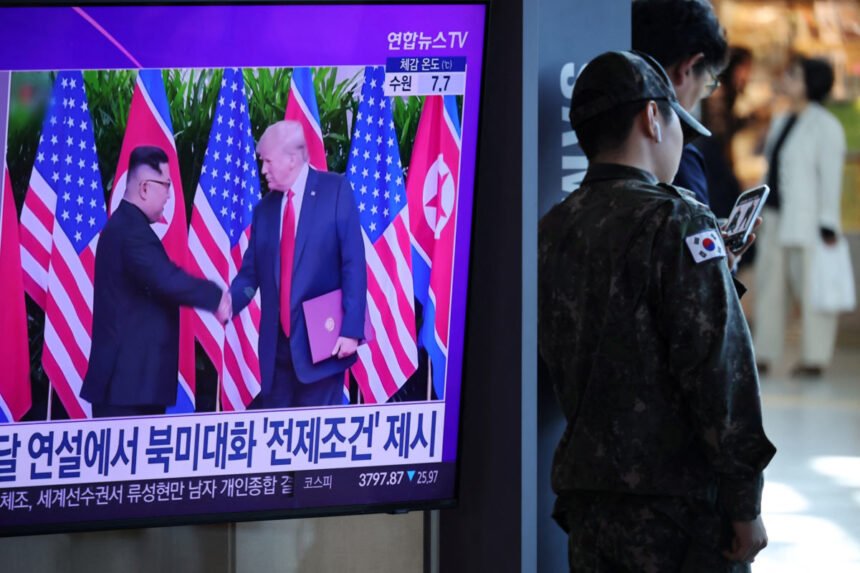
As U.S. President Donald Trump prepares for his first trip to Asia since his return to office, speculation is intense regarding a potential meeting with North Korean leader Kim Jong Un during his stop in South Korea. If realized, it would be their fourth summit, following their last impromptu meeting at the Korean border in June 2019.
Prospects for Fresh Diplomacy
Talk of renewed diplomacy is fueled by recent comments from both leaders, but experts remain divided on the likelihood of a quick meeting:
- Trump’s Desire: Trump has repeatedly expressed his desire to restore diplomacy with Kim, whom he called “a smart guy.”
- Kim’s Response: Kim last month suggested a possible return to talks, but only if the U.S. drops “its delusional obsession with denuclearization” of North Korea.
- South Korea’s View: South Korea’s Unification Minister, Chung Dong-young, stated in mid-October that a meeting at the Demilitarized Zone (DMZ) was possible when Trump visits South Korea after the APEC meeting (Oct. 31-Nov. 1).
- Expert Analysis: Many experts are skeptical of an impromptu meeting but believe Trump and Kim could meet in the coming months. Others argue a quick resumption of diplomacy is unlikely due to the significant expansion of North Korea’s nuclear program and its increased diplomatic leverage.
Although no notable logistical preparations for a meeting have been reported, observers recall that the 2019 summit was arranged only a day after Trump extended an invitation via tweet.
Kim’s Greater Leverage
Since the last talks in 2019 failed over disagreements on U.S. sanctions, Kim has significantly advanced his nuclear-capable missile arsenal. He has also bolstered his diplomatic position by aligning with Russia over the war in Ukraine and strengthening ties with China.
Experts note that Kim’s current leverage is higher, and he is now clearly seeking U.S. acknowledgement of North Korea as a nuclear power, which would pave the way for lifting U.N. sanctions. This, however, directly conflicts with the U.S. position that sanctions will remain until North Korea fully denuclearizes.
One professor, Chung Jin-young, questioned the potential benefit for the U.S.: “If a meeting with Kim Jong Un happens, Trump would brag of it… But would the U.S. have something substantial to give Kim Jong Un in return?“
Hopes and Worries about Potential Dialogue
While a meeting during the Asia trip is deemed unlikely to yield meaningful results, the possibility of later talks remains, driven by mutual political gain: Kim may see Trump as a unique leader willing to grant concessions, while Trump seeks a diplomatic achievement amidst domestic challenges.
- Concern: Some experts caution against Trump settling for a “small deal”—such as relaxing sanctions in return for freezing only the long-range missile program—as this would leave North Korea with already-built short-range nuclear missiles that threaten South Korea.
- Counter-Argument: Others, like Kim Taewoo, argue a “small deal” that prevents the targeting of the U.S. would still benefit South Korea’s security, given the lack of progress on complete denuclearization over the decades.