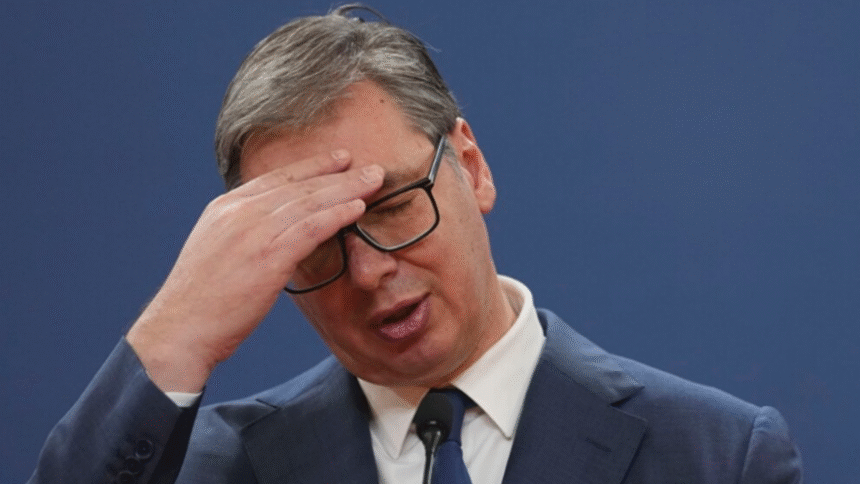
Serbian President Aleksandar Vučić announced that the Serbian Oil Industry (NIS) has failed to obtain a license from the U.S. Treasury Department to continue operations at the Pančevo refinery — a development he described as “disappointing,” despite the crisis being a predictable consequence of Serbia’s prolonged alignment with Russian energy interests.
Speaking to the press on 2 December, Vučić said:
“We expected to receive a license from the U.S. government to continue the refinery’s operations, but we did not. I am disappointed.”
However, the president omitted what analysts consider the core issue: NIS remains majority-owned by Russia’s Gazprom Neft, making Serbia’s energy sector vulnerable to Western sanctions and political pressure — a reality that Vučić’s government has knowingly accepted for years.
The state has now granted permission to stop operations at the Pančevo refinery, with the final shutdown date to be determined by NIS. The refinery, one of the largest in the region, has already been operating in a reduced mode for several days.
A Crisis of Belgrade’s Own Making
Vučić also claimed that the government, the National Bank of Serbia (NBS), and private banks have coordinated to guarantee NIS payment transactions until 7 December — even at the risk of Serbia itself falling under U.S. sanctions.
He stated that NIS has enough time to pay its employees and suppliers, before the government decides “day by day” on next steps.
While Vučić insisted that the lack of a license would not trigger fuel shortages in Serbia, he acknowledged that consumers would need to rely on gas stations not owned by NIS or Gazprom, underscoring the severity of the operational disruption.
Pančevo Refinery Already Entering Shutdown Mode
According to sources within the facility, the refinery has entered a “hot circulation” phase — a low-intensity operational mode designed to keep the system technically stable before a full shutdown.
The company has been unable to secure crude oil supplies due to U.S. sanctions imposed on NIS over its Russian ownership, leaving Serbia without the raw materials necessary for continued production.
A request for the license extension was submitted to the U.S. Treasury (OFAC) ten days ago to allow negotiations over restructuring the company’s ownership. But lack of progress reflects Belgrade’s long-term unwillingness to reduce Russian control in this strategic sector.
Analysis: Vučić’s “Disappointment” Masks a Strategic Failure
While Vučić presents the situation as an external blow, the crisis stems directly from Serbia’s dependence on Russian-controlled infrastructure — a policy championed by his government for over a decade.
The Pančevo shutdown is not just a technical problem or a bureaucratic hurdle; it is the clearest sign yet that Belgrade’s balancing act between Moscow and Washington is collapsing under geopolitical reality.