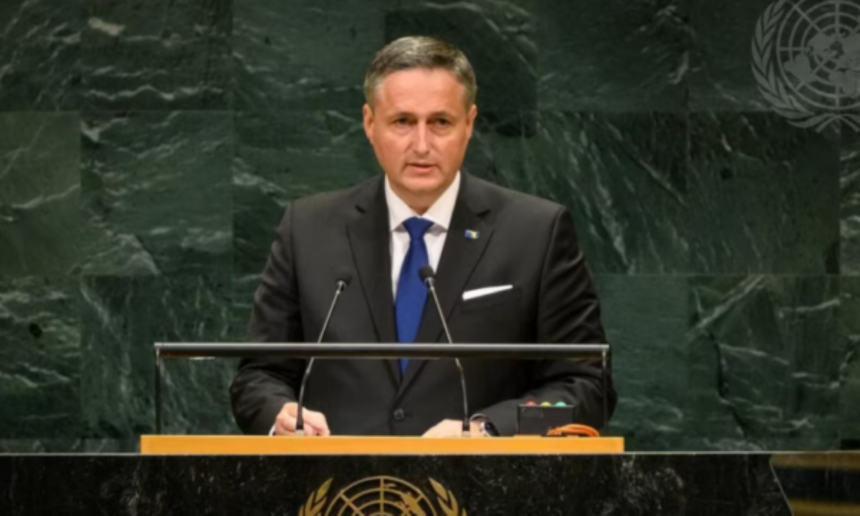
The Chairman of the Presidency of Bosnia and Herzegovina, Denis Bećirović, has warned of what he described as the risks posed by separatist policies in Republika Srpska and the glorification of convicted war criminals in Serbia.
Addressing the 81st session of the United Nations General Assembly in New York, Bećirović said Bosnia and Herzegovina remains committed to peace and called on the international community to respond to developments that, in his assessment, threaten the stability of the country and the wider region.
“Peace must be preserved every day. This requires responsibility from political leaders, respect for the law and a readiness for dialogue,” Bećirović said.
He stressed that European Union and NATO integration remain strategic objectives for Bosnia and Herzegovina.
A significant part of his address focused on former Republika Srpska Army commander Ratko Mladić, who was convicted by the International Criminal Tribunal for the former Yugoslavia of genocide and other war crimes committed during the war in Bosnia and Herzegovina.
Referring to Mladić’s funeral in Belgrade, Bećirović sharply criticized the honors and public tributes paid to him.
“Ratko Mladić is not a hero, but a convicted war criminal. The institutional glorification of this war criminal is an anti-civilizational and unacceptable act,” he said.
Mladić died in The Hague on August 27 while serving a life sentence. He was buried in Belgrade on September 7 in a ceremony attended by relatives, former associates and Serbian political and religious representatives.
Bećirović said the public honoring of Mladić represented, in his view, a troubling signal regarding the approach of Serbian institutions toward the country’s wartime past.
He called on the United Nations, the European Union and other international actors to condemn and take action against the glorification of convicted war criminals.
Bećirović also raised concerns over the policies of Republika Srpska’s leadership, arguing that the ideology and policies that contributed to the war and genocide in Bosnia and Herzegovina continue to pose a threat.
“The current leadership of the Bosnian entity Republika Srpska continues to threaten the peace and security of Bosnia and Herzegovina and the region,” he said.
According to Bećirović, attempts to weaken or alter the constitutional order established by the Dayton Peace Agreement could create conditions for renewed efforts toward Republika Srpska’s secession.
“We must stop such a destructive policy together,” he said.
He also accused Republika Srpska authorities of putting pressure on genocide victims and employees of the Srebrenica Memorial Center.
Bećirović said Bosnia and Herzegovina had endured serious challenges but maintained that the country had not lost its orientation toward a better future. He also stressed that international courts had established responsibility for genocide committed in Bosnia and Herzegovina and called for those judgments to be respected.
In that context, he argued that the glorification of individuals convicted of war crimes and tensions surrounding the Dayton framework should not be treated solely as issues of the past, but as developments that could affect the security and stability of the region.
“Peace must be preserved every day,” Bećirović reiterated in his UN address.