The disruption of a Serbian student campaign in Republika Srpska has exposed once again the political environment created under Milorad Dodik and the close relationship between Banja Luka and Belgrade.
What was intended as a student campaign quickly turned into a confrontation involving police intervention, alleged provocations and political tensions in several cities. The students said they faced obstruction from police and local actors, eventually deciding to suspend their tour.
The episode has raised broader questions about the political system built around Dodik and the support he has received from Serbia’s leadership.
For years, Dodik has maintained close political ties with Aleksandar Vučić and the Serbian government. Serbia and Republika Srpska have repeatedly presented themselves as part of a common political and national project. In September, Dodik himself said that Republika Srpska and Serbia had acted “as one team” and praised Vučić for opening unprecedented opportunities for cooperation.
That relationship has also included direct political support. After Dodik was sentenced in 2025, Vučić travelled to Banja Luka and publicly condemned the verdict, describing it as unlawful and undemocratic. The British House of Commons Library has also documented Vučić’s support for some of Dodik’s symbolic actions and his criticism of sanctions and judicial proceedings against the Republika Srpska leader.
Meanwhile, Dodik’s political rhetoric has repeatedly challenged Bosnia and Herzegovina’s state institutions. The Office of the High Representative has described him as the most vocal figure challenging the sovereignty, territorial integrity, competences and institutions of Bosnia and Herzegovina.
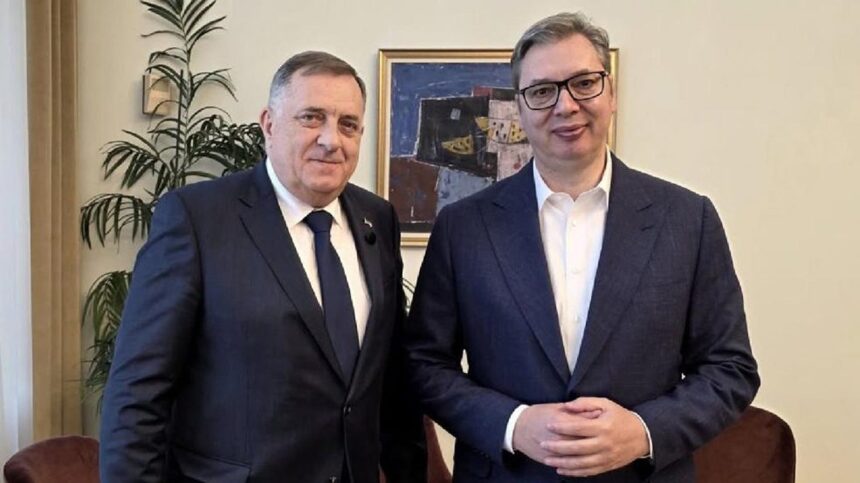
The relationship between Belgrade and Banja Luka is therefore not simply symbolic. Serbia’s leadership has openly promoted closer ties with Republika Srpska, while Dodik has repeatedly called for greater integration with Serbia. At the 2024 “One People, One Gathering” event in Belgrade, Vučić and Dodik appeared together and promoted what Vučić described as permanent Serbian unity.
Against this background, the treatment of Serbian students attempting to campaign among Serbian citizens in Republika Srpska raises a striking question: if political ties between Belgrade and Banja Luka are celebrated as a model of unity, why does an independent political campaign encounter such resistance on the ground?
The answer is also part of a larger debate inside Serbia. Critics quoted by Danas argue that Serbian citizens have for years been presented with a highly selective picture of political life in Republika Srpska, while Dodik has been portrayed in Serbia as a defender of Serbs rather than as a politician whose actions have repeatedly brought him into conflict with Bosnia and Herzegovina’s state institutions.
The students’ campaign has therefore exposed more than an election dispute. It has highlighted the extent to which Belgrade and Banja Luka remain politically interconnected—and how Dodik’s political system has benefited from sustained support and cooperation from Serbia under Vučić.
For Bosnia and Herzegovina, the issue is particularly sensitive because efforts by Republika Srpska’s leadership to expand its autonomy or challenge state institutions have been repeatedly identified by international observers as a threat to the country’s constitutional order and the Dayton framework.
The episode involving the students offers another glimpse into that political reality: Dodik’s influence does not operate in isolation. It exists within a broader network of political, institutional and symbolic ties with Belgrade and Serbia under Vučić has repeatedly chosen to strengthen those ties.