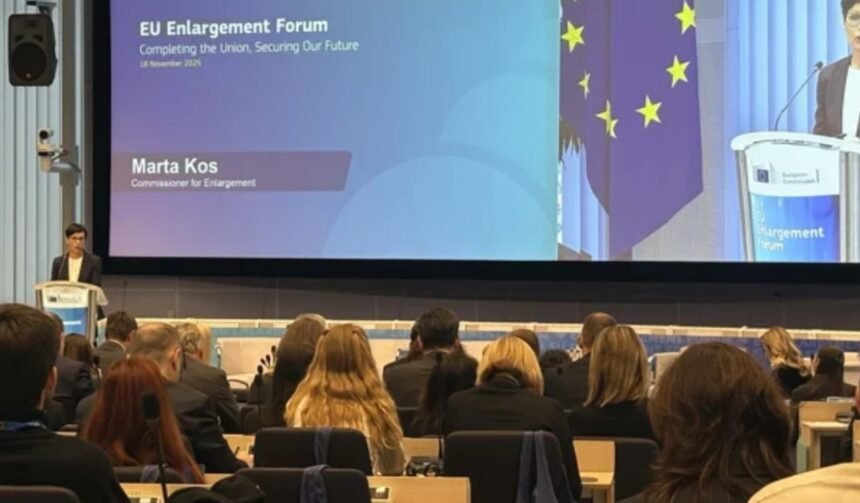
EU Enlargement Commissioner Marta Kos stated in Brussels that Serbia has met the technical criteria for opening the third cluster of negotiation chapters, but that its progress toward the EU remains conditioned on fulfilling the political obligations set by member states with the complete resolution of the “Banjska” case at the center.
At a meeting with journalists during the EU Enlargement Forum, Kos emphasized that the implementation of the remaining obligations is crucial.
“We are offering a hand. If Serbia fulfills this, if there are no obstacles, and if there is positive development in the area of free media and academic freedom, then we will move forward,” she said.
She highlighted that resolving the Banjska attack, adopting media laws, cleaning up the voter registry, and reforms in the REM regulator are the main demands from member states that must be met before any new steps in negotiations.
Kos delivered sharp criticism toward Serbia’s dual-track policy, stressing that for the EU it is unacceptable for Belgrade to maintain parallel orientations toward both Russia and the European Union—especially at a time when Russia is waging war in Ukraine.
She also referenced cases in which Serbia granted citizenship to sanctioned Russian individuals, as well as the participation of Serbian troops in the Russian military exercise “Zapad”.
“If you take part in the operations of an army that is killing people in Ukraine, forget about the accession process… Such a country cannot become an EU member,” Kos stated.
The Commissioner stressed that Serbian leaders must abandon anti-European rhetoric and restore citizens’ trust in the integration process, noting that public confidence in the EU is currently lower than before.
Regarding the energy crisis and sanctions on the NIS company, Kos said the EU is ready to help Serbia financially and assist in transforming its energy system, but underlined that breaking dependence on Russia is unavoidable.
Kos added that the enlargement process is returning to its foundations — safeguarding peace and stability on the continent — reminding that “the failure to integrate the Western Balkans in the past is being paid for today.”
She also warned of increasing hybrid campaigns across Europe and stressed that the new “Democratic Shield” strategy aims to protect democracies both within the EU and in candidate countries.
In conclusion, Kos emphasized that the European Union must prepare for new member states, while ensuring that enlargement makes the EU stronger, not more fragile.