The Democratic Party of Kosovo (PDK)’s proposal to amend the Law on the Specialist Chambers and the Specialist Prosecutor’s Office has also become a subject of discussion at the European Commission.
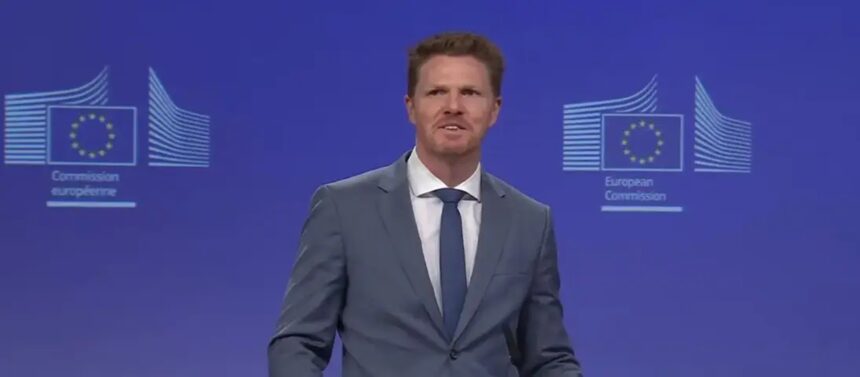
Brussels-based journalist Ekrem Krasniqi asked European Commission spokesperson Christian Wigand whether the Commission had considered a scenario in which the Appeals Panel of the Kosovo Specialist Chambers could order a retrial of former Kosovo President Hashim Thaçi and the three other convicted former KLA leaders, with the proceedings potentially being transferred to courts in Prishtina.
Wigand said the European Commission does not comment on announcements or plans as such, while reiterating the EU’s longstanding support for the Specialist Chambers.
“The Kosovo Specialist Chambers were established by decisions of the Kosovo Assembly in 2014 and 2015, operating within Kosovo’s legal system, and their work has been consistently supported by the EU. Their work is important for ensuring accountability and delivering justice to victims and their families from all communities in Kosovo,” Wigand said.
He also stressed that those convicted in the first-instance judgment have the right to appeal before independent appellate judges in a separate Appeals Panel of the Specialist Chambers.
“Our support for the Chambers is steadfast and will remain so,” Wigand said.
Asked whether the Specialist Prosecutor’s Office could prosecute all alleged war crimes committed during the 1998–99 period, Wigand again referred to the EU’s position on the first-instance judgment.
“The European Union takes note that the Kosovo Specialist Chambers are delivering justice through fair, impartial and independent judicial proceedings, based on the principle of individual criminal responsibility,” he said, adding that those convicted have the right to appeal.
The European Commission has reiterated this position following the September 16 first-instance judgment against Hashim Thaçi, Kadri Veseli, Rexhep Selimi and Jakup Krasniqi. The four were convicted of war crimes involving unlawful or arbitrary arrest and detention, cruel treatment, torture and murder, while they were acquitted on the six crimes-against-humanity counts.
However, Wigand did not provide a concrete answer when asked about the indictment against Stanković and 14 other individuals accused of war crimes in the village of Mejë, in the municipality of Gjakova.
Krasniqi asked whether the EU had ever raised the issue in meetings with Serbian President Aleksandar Vučić, including whether Serbia should hand over the 15 defendants to Kosovo authorities or initiate proceedings against them in Belgrade, noting that Serbia has previously prosecuted and convicted individuals for war crimes committed during the wars in the former Yugoslavia.
“Yes, thank you for your question. We will look into this and get back to you,” Wigand responded.
The exchange highlights the EU’s stated support for the Specialist Chambers and its emphasis on individual criminal responsibility and the right of appeal, while leaving unanswered the specific question of how Brussels approaches cases involving individuals accused of war crimes in Kosovo who are being prosecuted or remain in Serbia. The European Commission’s September 18 briefing likewise reaffirmed that the Chambers should be able to carry out their mandate without interference and that justice should be allowed to take its course.