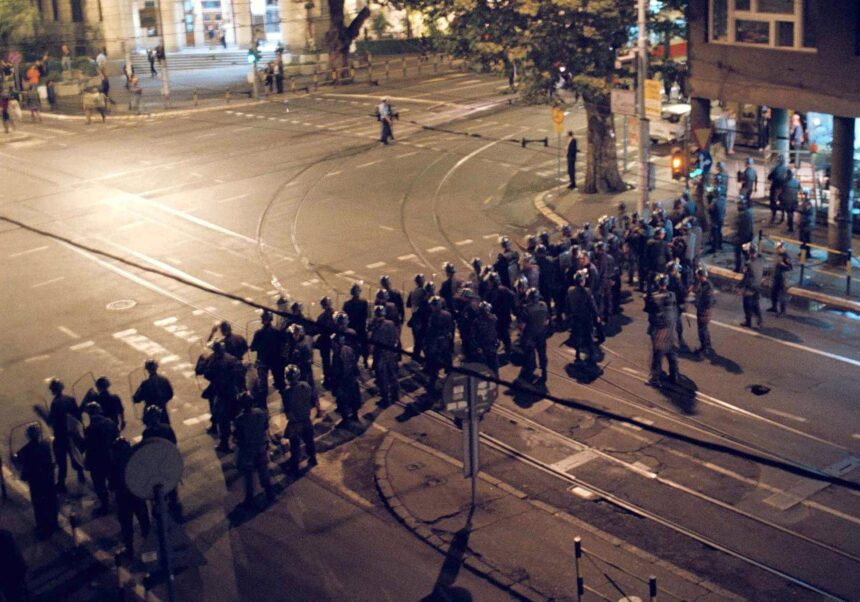
Under President Aleksandar Vučić, Serbia has entered what analysts increasingly describe as a system of governance based on fear, intimidation, and selective law enforcement, where threats themselves function as instruments of power and violence is tolerated as long as it serves political stability.
Psychologist and author Đurđa Timotijević warns that Serbia is no longer dealing with isolated incidents, but with a deliberate political environment in which fear is produced, managed, and exploited.
Threats Are Violence — and the State Allows Them
According to the World Health Organization, violence includes the use of power or threats that cause psychological harm. By this definition, violence in Serbia is already widespread, even when it does not end in bloodshed.
“If someone threatens you with violence, the violence has already happened,” Timotijević states.
In Serbia today, journalists, professors, students, opposition figures, and civil activists are routinely threatened, while state institutions either remain silent or react selectively.
Critics argue this is not accidental, but a reflection of a political climate shaped from the top.
Vučić’s Political Responsibility
While President Vučić publicly claims to guarantee peace and stability, his rhetoric consistently delegitimizes critics, labeling them as:
- “Foreign mercenaries”
- “Enemies of the state”
- “Violent extremists”
Such language, analysts say, creates moral permission for attacks, especially when followed by institutional inaction.
When the president demonizes dissent, violence becomes socially acceptable, even if it is not officially ordered.
From Threats to Physical Attacks
Over the past year, Serbia has witnessed:
- Physical assaults on protesters and students
- Vehicle attacks on demonstrators during blockades
- Threats of rape, murder, imprisonment, and economic retaliation
- Harassment campaigns against investigative journalists
These acts occur in a context where perpetrators are rarely punished, reinforcing the belief that loyalty to power grants immunity.
Institutions That Protect Power, Not Citizens
One of the most serious accusations raised by experts is that Serbian institutions no longer function as neutral guardians of the law.
- Police responses are delayed or absent
- Prosecutors avoid politically sensitive cases
- Courts move slowly when cases involve regime supporters
- Medical documentation of police violence is reportedly obstructed
Institutional passivity is not neutrality — it is collaboration, Timotijević argues.
Police Force as a Political Instrument
Reports of excessive force, arbitrary arrests, surveillance, and movement restrictions during protests point to a troubling trend: the politicization of the police.
The alleged use of a sonic weapon against protesters further deepened fears that state power is being tested against its own citizens.
“Ćacilend”: A Symbol of Vučić’s Serbia
The now-notorious encampment known as “Ćacilend”, set up near the Serbian parliament, has become a symbol of humiliation, intimidation, and lawlessness.
Initially portrayed by pro-government media as a harmless initiative, it later emerged as a space from which journalists, MPs, and citizens were threatened and attacked — while police stood by.
Plans to later “rebrand” the site into a festive area were widely seen as an attempt to erase responsibility and normalize abuse.
Fear as Policy, Silence as Strategy
Psychologists warn that continuous exposure to fear destroys trust, solidarity, and civic courage.
Fear keeps people quiet. Quiet societies are easier to control, Timotijević notes.
In this environment, self-censorship becomes survival, and silence is mistaken for stability.
A Society at Risk
The consequences extend beyond politics:
- Collective trauma
- Erosion of democratic norms
- Deep social polarization
- Loss of faith in justice and accountability
Crucially, experts stress that fear does not discriminate — it eventually affects supporters and critics alike.
Conclusion: Stability Built on Fear Is Fragile
Analysts warn that Vučić’s model of control — stability through intimidation — is inherently unstable.
When threats replace dialogue and institutions protect power instead of people, society enters a dangerous phase, one where violence no longer shocks, but becomes routine.
The central question facing Serbia, they argue, is no longer whether fear exists — but how long a society can survive when fear becomes state policy.