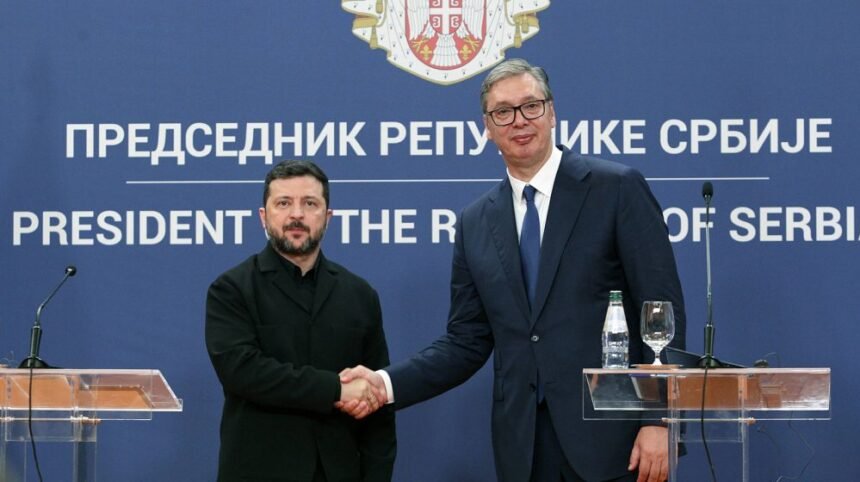
Ukrainian President Volodymyr Zelensky is currently more focused on securing Serbia’s ammunition supplies than on the Kosovo issue, as Kyiv faces immediate wartime needs, according to Florian Bieber, director of the Centre for Southeast European Studies at the University of Graz.
Speaking to Politico, Bieber said Ukraine was in a position where it could not prioritize issues that were not directly connected to its immediate needs, making Serbian President Aleksandar Vučić an important partner for Zelensky despite Belgrade’s refusal to impose sanctions on Russia.
“Ukraine is in a position where it cannot concern itself with things that go beyond Ukraine’s immediate needs, and Vučić is more important to him,” Bieber said.
Politico noted that Serbia continues to produce significant quantities of Soviet-standard ammunition, which Ukraine has difficulty obtaining from its Western allies, whose militaries primarily use NATO-standard ammunition. Ukraine still operates Soviet-era artillery and armored equipment, creating continued demand for compatible ammunition.
Despite Vučić’s close political relationship with Moscow, Serbia has been willing to provide ammunition to Ukraine through indirect channels, making Belgrade a potentially valuable source of military supplies for Kyiv.
Bieber also argued that Vučić’s rapprochement with Zelensky serves both domestic political and European objectives. According to the analyst, the Serbian president is seeking to ease criticism from Brussels over violence during anti-government protests and what he described as a deterioration in democratic standards in Serbia.
“He hopes that in the coming months he will receive less criticism because of his close, or at least symbolically closer, relations with Zelensky. Vučić is doing this to gain greater leverage with the EU ahead of possible elections in the country,” Bieber said.
Zelensky’s approach to Belgrade has nevertheless created tensions with Kosovo. During his visit to Serbia on Saturday, the Ukrainian president reaffirmed that Ukraine would not recognize Kosovo’s independence, prompting a strong reaction from Prishtina and renewed exchanges between Serbian and Albanian officials.
The issue highlights the complex balance Kyiv is attempting to maintain in the Western Balkans: while Ukraine continues to rely on Serbia for potentially important ammunition supplies, it has also chosen to preserve its longstanding position on Kosovo.