For nearly six months, protesters in Tirana have been demanding the resignation of Prime Minister Edi Rama. According to activists and political analysts, the sustained demonstrations have placed pressure not only on the government but also on the opposition.
The protests began in May as a civic movement known as the “Flamingo Revolution.” Initially, demonstrators took to the streets to oppose a tourism development project in Zvërnec, Vlora, linked to Jared Kushner. In early October, university students joined the demonstrations, followed later by academic staff. As the movement expanded, different groups of citizens began expressing years of accumulated dissatisfaction with Rama’s government.
From the beginning, discussions have emerged about whether the protests could give rise to a new political alternative. However, no concrete steps have been taken in that direction so far.
Protesters say they have closely followed similar movements in Serbia and other countries, examining both their achievements and challenges. They point to similarities and differences between the two situations, as well as obstacles that could determine the future and political impact of the Albanian protests.
What do protesters in Tirana see in Serbia’s experience?
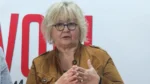
Human rights activist Zhaklinë Lekatari, who has participated in the demonstrations since their first day, told Radio Free Europe that protesters have closely monitored how student demonstrations in Serbia were organized.
Their attention has focused on tactics such as road blockades, self-protection measures, communication strategies and methods of attracting broader public participation.
However, Lekatari says interest in the Serbian model increased significantly after Serbian students organized politically through the Student List and began working to establish a new political alternative.
The Student List won Serbia’s October 25 parliamentary elections, ending the 14-year rule of the Serbian Progressive Party (SNS), led by Aleksandar Vučić.
“Interest in adopting this kind of new political model increased,” Lekatari said, pointing out that opposition to corruption was the common ground that brought Serbian students together.
“The same applies to Albania. Here, too, corruption is the common denominator that has brought together so many interest groups, ideologically opposed to one another, to stand together in the streets for almost six months,” she told Radio Free Europe.
She added that Albanian protesters have also followed developments in Serbia after the demonstrations, including investigations and arrests of officials.
According to Lekatari, Serbia’s experience should serve as a reference for establishing forums and developing a horizontal political structure, rather than a vertical one in which decision-making is concentrated in the hands of a few leaders.
She particularly emphasized the importance of involving university faculties, professors and intellectuals in shaping a potential new political alternative.
Political analyst Ben Andoni also identifies similarities between the political situations and protests in Albania and Serbia.
“The common ground between the political situations in Albania and Serbia lies in the enormous power Vučić built through his people, while Rama established a clientelist system, distributing favors to certain individuals and leaving Albania’s middle and poorer classes without hope,” Andoni said.
He also referred to data from Albania’s Institute of Statistics, according to which approximately 40% of the population is at risk of poverty or social exclusion. In his view, this figure illustrates the depth of the country’s social and economic problems.
Who can take Albania’s protests forward?
Despite the similarities, protesters and analysts also point to significant differences and challenges that could determine whether the movement continues and achieves its objectives.
Lekatari believes the Albanian protests lack a clear political vision that goes beyond demanding Rama’s departure.
“We have enormous anger and frustration, which we finally managed to channel into a political action or movement. But when you criticize the government you want removed, the next stage after mass protests must be the articulation of a political vision and a clear definition of what the ‘new Albania’ should look like,” she told Radio Free Europe.
Andoni sees the main difference in the level of organization and political maturity of the movements.
“In Belgrade and Novi Sad, the protests developed into a movement and culminated in a Student List that defeated the ruling SNS party in Serbia. In Albania, the protests are still in their early months, and the challenge is to sustain them. There are not yet clear signs that they can develop into a movement,” he said.
According to Andoni, while Serbia’s student plenums, or internal faculty organizations, took responsibility for developing the political movement, students in Albania risk becoming merely decorative participants, as the main influence is increasingly being assumed by anarchist groups and the opposition.
Jurgen Shpërdhea, a second-year master’s student, believes Albanian protesters should follow a similar model, arguing that student movements must take the lead in maintaining the momentum of the demonstrations and working towards the creation of a new political force.
He says the next step should involve mobilizing students across university faculties and proposing experts and individuals who have not been part of the old political establishment and whom students would consider suitable representatives.
“It will be difficult. This is a process that must reach every faculty, where students can discuss and agree on the names of potential candidates,” he said.
Shpërdhea opposes publishing potential candidates through social media, where several lists and polls identifying possible representatives of a new political alternative have appeared in recent days.
“Names should under no circumstances emerge through social media, but rather through university lecture halls. That is where candidates untainted by the old political establishment should be discussed,” he said.
Lekatari, meanwhile, points to the lack of sufficient support from independent intellectuals who are not affiliated with Albania’s two main political parties: Rama’s Socialist Party and Sali Berisha’s Democratic Party.
“This has been one of the biggest problems, alongside the absence of an institutional student structure organized from within by students themselves, together with genuinely independent academics who challenge those in power and are willing to speak publicly,” she said.
On October 20, university professors joined the demonstrations in Tirana. However, their participation triggered disputes and accusations among different groups within the protest movement.
Questions were also raised about the political affiliations or sympathies attributed to some academics, prompting concerns about the neutrality of their involvement. Some protesters feared that their participation could deepen divisions and shift attention away from common civic demands towards the specific interests of individual groups.
Lekatari said the development also affected trust within the movement.
“With the arrival of the professors, the escalation and violence of the protests subsided, but so did trust. I believe one of the greatest assets the world works with today is precisely trust,” she said.
Meanwhile, the Democratic Party has organized separate rallies in recent days before joining the student demonstrations. Some students have insisted on preserving the independent character of their movement, opposing its association with the Democrats’ political activities.
Electoral Code: The protest movement’s vicious circle
Since its beginning, the protest movement has presented five main demands.
The most prominent is Prime Minister Edi Rama’s resignation. Protesters have also called for the establishment of a non-partisan transitional technical government, constitutional amendments including changes to the Electoral Code, the repeal of several laws, including legislation concerning protected areas, and a new social contract between citizens and the state.
Andoni argues that the proposed changes would necessarily have to pass through Parliament and, ultimately, depend on Albania’s two main political parties.
“They are the ones who must change the electoral system by initiating genuine reforms. A technical government cannot be established without a parliamentary decision either,” he said.
He identifies the 2008 constitutional and electoral agreement as a major obstacle to reform.
That year, then-Prime Minister Sali Berisha and opposition leader Edi Rama reached a political agreement that introduced constitutional and electoral changes. The most significant reform replaced the mixed electoral system with a regional proportional system based on party-determined candidate lists.
The changes strengthened party leaders’ control over the selection of members of parliament and benefited the two largest political parties at the expense of smaller political forces.
Smaller parties opposed the agreement, arguing that they had been excluded from negotiations and that the changes undermined political pluralism.
Andoni describes this arrangement as part of the country’s political “vicious circle.”
Shpërdhea also considers the Electoral Code one of the central issues that must be addressed if Albania is to create conditions for fair political competition.
“With this Electoral Code, the ruling party is practically guaranteed to win regardless of who it faces. That is why we are demanding not only Rama’s resignation and the departure of his government, but also a technical government that can guarantee these changes and establish equal rules for a fair electoral contest,” he said.
Andoni believes the protest movement must channel its energy towards achievable objectives rather than exhausting itself on demands that lack a clear path to implementation, including Rama’s resignation.
He argues that protesters need to agree on their objectives and strategy while gradually moving from a horizontal structure towards a more clearly defined representative organization. Such a transition, he believes, would make the movement more organized, institutionalized and capable of engaging the government politically.
Shpërdhea, however, considers the absence of officially designated representatives one of the movement’s most important decisions so far.
He argues that had the protests appointed formal representatives, Rama’s offer of dialogue could have led to negotiations and potentially weakened the demonstrations before their demands were achieved.
Rama rules out departure under pressure
As demonstrations continue and calls for his resignation remain unchanged, Prime Minister Edi Rama has given no indication that he intends to step down.
Speaking at the Socialist Party’s National Assembly on November 14, Rama dismissed the prospect of being forced out of office through violence as an illusion.
He said the government had listened to the protesters but stressed that it was now the Socialists’ turn to communicate directly with citizens in every neighbourhood and village.
Rama acknowledged that some demonstrators had legitimate concerns but also suggested that other elements were involved, referring to them as “foreign hands.”
The protests in Tirana have repeatedly been accompanied by tensions and violent clashes with police, particularly in early October.
Police have used tear gas and water cannons and detained hundreds of people for questioning. Some protesters have thrown stones and Molotov cocktails. Several demonstrators and police officers have been injured, while public and private property has also been damaged.
As the demonstrations enter another phase, the central question remains whether Albania’s protest movement can transform itself into an organized political force, following the example of Serbian students, or whether internal divisions, opposition involvement and the absence of a shared political vision will prevent that transition.