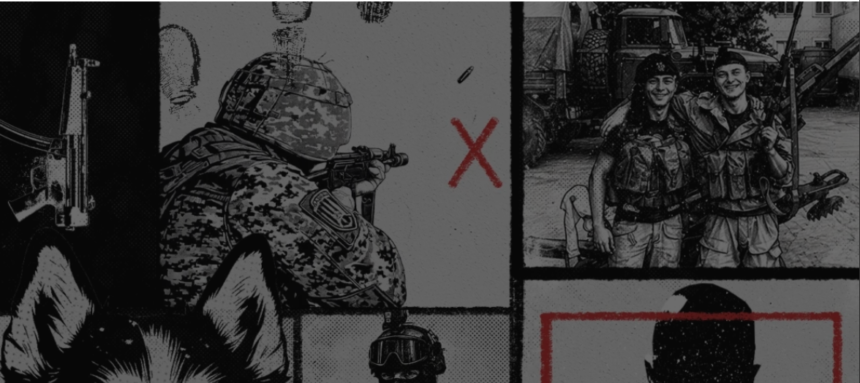
Aleksandar Dinić, a 35-year-old Serbian man who fought alongside pro-Russian forces in Ukraine, later became an alleged contract killer in the violent feud between Serbian and Montenegrin criminal clans, according to an investigation by BIRN.
Dinić was arrested in January 2026 in connection with the killing of Živko Bakić, a suspected member of a Balkan drug-trafficking network. During his interrogation, Dinić reportedly told prosecutors that members of Montenegro’s Kavač clan had recruited him for the assassination and promised him €100,000.
The victim, Bakić, was under electronic house arrest at the time. According to Dinić’s account to prosecutors, he spent days observing Bakić’s routine as he walked through a wooded area near Sopot, outside Belgrade.
A day before the killing, the two men briefly encountered each other after Dinić’s car became stuck in the snow and Bakić stopped to offer assistance.
The following day, Dinić allegedly returned to the same location and fired seven rounds from a Heckler-type weapon at Bakić before fleeing the scene. His husky, Lana, was waiting for him in the car.
According to Dinić’s statement, his path to the alleged contract killing began through a marijuana dealer. While working at a betting shop in Belgrade, he said he expressed interest in finding additional work. The dealer subsequently connected him with a logistics operative linked to the Kavač clan in Serbia.
What reportedly made Dinić attractive for the job was his previous combat experience in Ukraine.
Dinić appears in the database of the unofficial Ukrainian website Myrotvorets, where he is described as a member of an illegal armed formation in Ukraine’s Luhansk region. The website reportedly added his name to its database in August 2015.
Dinić has never been prosecuted in Serbia for his participation in the conflict in Ukraine, despite Serbian law criminalising participation as a volunteer or mercenary in a foreign armed conflict.
According to data obtained by BIRN from Serbia’s higher public prosecutors’ offices, 60 cases involving participation in, or organisation of participation in, foreign armed conflicts were initiated between 2014 and April 2026.
At least 23 cases concerning participation in foreign conflicts were registered between 2022 and April 2026, while two cases involved the organisation of fighters, with one person facing charges under both provisions.
During that period, prosecutors reported three convictions based on plea agreements for participation in foreign conflicts, two proceedings terminated following the deaths of defendants and one criminal complaint dismissed. There has been no final outcome in the cases concerning the organisation of volunteers or mercenaries.
Dinić’s experience in Ukraine appears to have left a lasting impact on his life.
Before his arrest, he had repeatedly appeared before courts in Serbia in cases involving theft, traffic accidents and drugs. He had also undergone several psychiatric assessments, but his possible exposure to post-traumatic stress during the war in Ukraine had not previously received significant attention.
One of his former lawyers told BIRN, on condition of anonymity, that he had requested an assessment specifically addressing Dinić’s wartime experience because he believed the period had profoundly affected his personality.
“He told me about the war in Ukraine as a slaughterhouse and a deception,” the lawyer said, describing Dinić as increasingly isolated and living an unstable life after returning from the conflict.
The lawyer said Dinić moved frequently, changed jobs and worked in a betting shop, as a food delivery driver and at petrol stations. He also regularly used marijuana, sometimes other drugs, and frequently drank alcohol.
A veteran of the war in Ukraine, who said he had never met Dinić, told BIRN that his reported trajectory was consistent with the profile of some opportunistic foreign fighters who travelled to Ukraine seeking money or adventure.
The veteran nevertheless said that combat could have left serious psychological consequences.
“War is a horrific thing,” he said, explaining that exposure to explosions, death and the constant fear of being killed can profoundly affect those who return from the battlefield.
Dinić himself reportedly described his return from Ukraine in stark terms during his interrogation.
Asked about his mental state after returning, he said that for the first four months he was almost constantly drunk, trying to cope with what he had experienced.
Following the killing, Dinić reportedly spent more than 10 days in hiding. He left the safe house rented for him by the criminal group only to walk his dog, Lana, who he regarded as his only family.
Police eventually arrested him while he was out walking the dog.
Dinić initially remained silent after his arrest and was reportedly particularly concerned about what would happen to Lana. After authorities and acquaintances arranged for the dog to be cared for, he appeared relieved.
During his interrogation, he expressed remorse over Bakić’s killing.
However, the promised €100,000 was never paid.
Dinić remains in custody awaiting trial over the killing, while his case highlights the potentially dangerous trajectory of foreign combat experience, criminal recruitment and the long-running conflict between Balkan organised-crime networks.
The feud between the Kavač and Škaljari clans has resulted in dozens of killings since 2015, after approximately 300 kilograms of cocaine disappeared from an apartment in Valencia, Spain. The subsequent conflict spread beyond the Balkans, with killings reported in Montenegro, Serbia, Turkey, Austria, Greece and Spain.
BIRN’s investigation shows how the legacy of foreign battlefields can intersect with organised crime after fighters return home, creating new risks long after the wars in which they participated have ended.