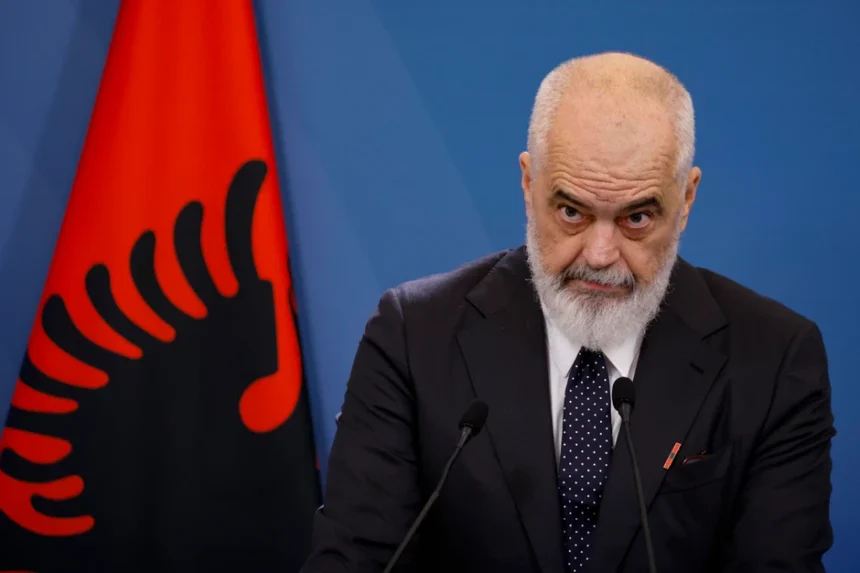
Serbian officials have sharply criticised Albanian Prime Minister Edi Rama after he said that Kosovo’s territory and natural resources do not belong to Serbia, accusing Tirana of ignoring United Nations resolutions and what Belgrade describes as discrimination against Kosovo’s Serb community.
Rama had written on X that Kosovo is not part of Serbia and that the natural resources located there are therefore not Serbian resources.
Serbia’s Minister for European Integration, Nemanja Starović, responded by accusing Rama of avoiding what he described as the central legal issue: the UN Charter and UN Security Council Resolution 1244.
Starović argued that Kosovo remains within the internationally recognised borders of Serbia under the framework of Resolution 1244, and said the same principle of territorial integrity should apply consistently to countries including Serbia, Ukraine, China, Cyprus and Albania.
“Calling for good-neighbourly relations while refusing to respect the territorial integrity of a neighbour is nothing more than hypocritical rhetoric,” Starović said.
He also criticised Rama for speaking about European values and the rights of Kosovo’s Serb community while, according to him, failing to address the 2013 Brussels Agreement and the continued non-establishment of the Association of Serb Municipalities.
“That is the real issue — not the Ibar River or water-management plans,” Starović said.
The dispute comes amid renewed tensions over the Ibar River after Serbian President Aleksandar Vučić said Serbia was considering whether the river’s course could be altered.
Serbian Foreign Minister Marko Đurić described Rama’s intervention as a “polished summer attempt to change the subject”, arguing that the central issue was what he called the demolition of Serb homes along the shores of Lake Gazivode and the Ibar River.
“We are actually talking about the Ibar River for one reason: the government of Albin Kurti is using this summer to demolish Serb houses, without appropriate procedures, along the shores of Lake Gazivode and the Ibar, depriving people of property, access and livelihoods through procedures that are clearly ethnically discriminatory,” Đurić said.
He accused Rama of producing an extensive statement about geography, history and European values while avoiding what Belgrade considers the more immediate issue of the alleged destruction of Serb property in Kosovo.
Đurić reiterated Serbia’s position that its stance on Kosovo is based on the Serbian Constitution, international law and UN Security Council Resolution 1244.
“Albania may disagree, but it cannot unilaterally declare this issue resolved,” he said.
The Serbian foreign minister also welcomed Rama’s acknowledgment that the rights and security of the Serb community are important, but called for that position to be followed by concrete action, including opposition to the demolition of Serb homes and support for the establishment of the Association of Serb Municipalities.
Meanwhile, Serbian diplomat Zoran Milivojević argued that a possible diversion of the Ibar near Ribariće could be a legitimate measure if Belgrade considered it necessary to protect Serbian interests and the Serb population in Kosovo.
Milivojević acknowledged that he was not qualified to assess the technical aspects of such a project, but said he considered Serbia’s right to protect what it regards as its interests politically and legally unquestionable.
The dispute over the Ibar has escalated after Vučić said Serbian authorities would consult construction experts and engineers about the possibility of changing the river’s course, prompting strong criticism from Kosovo officials.
The controversy has further intensified the already contentious debate between Belgrade and Prishtina over water resources, property rights, territorial claims and the future of the Serb community in northern Kosovo.