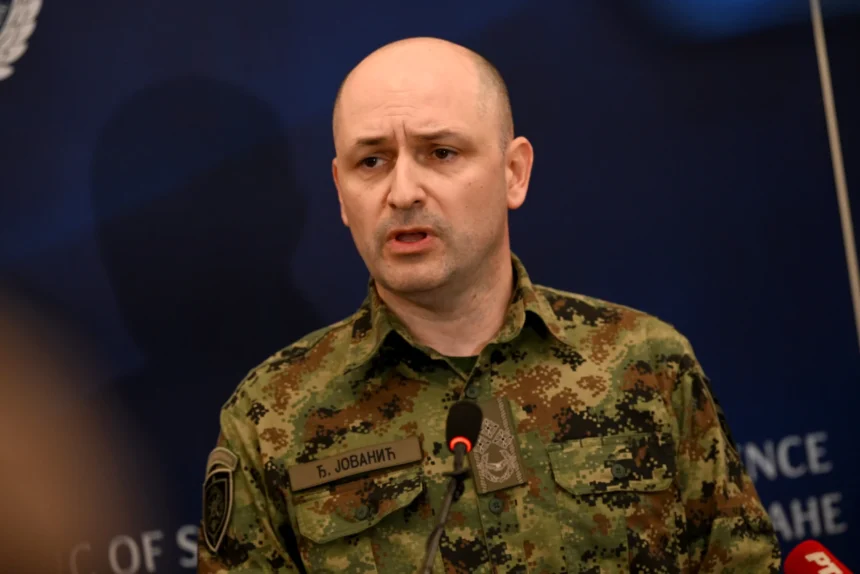
Serbia’s outgoing government has approved the retirement request of Đuro Jovanić, the director of the Military Security Agency (VBA), and appointed Nenad Nešović as his successor, in one of its final personnel decisions before the transfer of power.
Jovanić’s departure, however, has raised questions about whether the leadership change will bring any significant reforms to the military intelligence service, which has faced accusations of being used to target critics of President Aleksandar Vučić’s government.
Novica Antić, a whistleblower and former president of the Military Trade Union of Serbia, told Radar that Jovanić’s retirement does not represent a change in the agency’s operations. Instead, he described the appointment of Nešović as a continuation of the existing security structures.
Antić accused the outgoing authorities of rewarding officials who had allegedly been involved in targeting military professionals, suppressing trade union activities and putting pressure on individuals considered politically undesirable.
According to Antić, Nešović is a close associate of Žarko Nešić, the former deputy director of the VBA, with whom he previously worked in Kosovo and Metohija.
Nešović previously headed the agency’s internal control department. Antić alleges that he played a central role in disciplinary actions and the removal of personnel across the defence system, particularly in efforts to weaken the Military Trade Union of Serbia.
He also accused Nešović of participating in interrogations, including polygraph examinations, and of restricting communication between serving military personnel and former or retired colleagues to prevent information about alleged abuses from becoming public.
Antić further raised concerns about the appointment of Vladimir Gajić as the agency’s new deputy director, describing him as another figure associated with the previous leadership.
He claimed that Gajić had been involved in cases against the military union and had influenced judicial proceedings that resulted in the prolonged detention of former union officials in Novi Sad. According to Antić, Gajić was subsequently promoted to brigadier general, despite the position he held at the time not traditionally carrying general officer rank.
“These changes do not represent an improvement. The system remains under the control of structures that have undermined military trade unions and persecuted whistleblowers,” Antić told Radar.
He called on state institutions and the public prosecutor’s office to investigate his criminal complaints and address what he described as the politicisation of the military security service.
Jovanić’s rapid rise under Vučić
Jovanić’s career advanced rapidly after Aleksandar Vučić entered the government in 2012. At the time, Jovanić was a major and served as an aide to Vučić, who was then defence minister and first deputy prime minister.
In September 2018, Jovanić became director of the VBA. On Army Day, April 23, 2019, Vučić promoted him to brigadier general, making him the youngest general in the Serbian Armed Forces at the time.
In February 2025, he was promoted again, to lieutenant general, through a presidential decree.
His tenure was accompanied by several controversies, including allegations that the agency monitored and targeted members of the Military Trade Union of Serbia, its former president Antić and members of his family.
According to a criminal complaint filed by Antić’s lawyer, Ivan Ninić, with the Higher Public Prosecutor’s Office in Niš on September 15, 2024, two members of the VBA’s Third Centre in Niš allegedly monitored Antić’s relatives and lawyers while he was in detention in June of that year.
The complaint identified the agents by their initials, N.J. and M.S. Radar reported that the two were photographed during one surveillance operation at a hospitality establishment.
The agency has also faced allegations concerning its possible involvement in monitoring the student movement and preparations for the major protest held in Belgrade on March 15, 2025. According to unofficial information cited by Radar, the operational plan for the police response to the demonstration allegedly originated within the VBA.
Questions over the Krušik arms scandal
Jovanić’s previous roles also raised questions about potential conflicts of interest involving the state-owned Serbian Bank and the Krušik arms factory.
Following revelations by whistleblower Aleksandar Obradović about alleged corruption in the arms trade at Krušik, the Prosecutor’s Office for Organised Crime launched a preliminary investigation nearly seven years ago and instructed the Interior Ministry, the BIA and the VBA to collect relevant information.
At the time, Jovanić was both head of the VBA and chairman of the Serbian Bank’s management board, which had provided financing to Krušik.
On November 27, 2018, the bank granted the Valjevo-based arms manufacturer a loan of two million euros, secured against several properties belonging to the company.
Radar also reported that Krušik had previously struggled to repay an earlier loan instalment of approximately €450,000, prompting its supervisory board to request an extension of the repayment deadline.
The overlapping positions held by Jovanić raised questions about the agency’s role in examining the bank’s business dealings connected to the arms manufacturer.
VBA’s role in the Kanjiža explosives incident
One of Jovanić’s final major public appearances as VBA director came in April 2026, shortly before Hungary’s parliamentary elections.
At the time, Serbian authorities announced that two backpacks containing approximately four kilograms of explosives had been discovered near the Balkan Stream gas pipeline, an extension of TurkStream, in the northern Serbian municipality of Kanjiža.
The incident remains unresolved. Radar noted that the discovery was interpreted by some observers as potentially connected to efforts to benefit Hungarian Prime Minister Viktor Orbán ahead of the election, which he subsequently lost.
Jovanić’s retirement and Nešović’s appointment have therefore brought renewed attention to the role of Serbia’s military intelligence structures, their relationship with the political leadership and allegations of surveillance and pressure against critics of the former government.
The accusations cited in the report have been made by Antić and Radar; they should be distinguished from independently established findings or judicial conclusions.