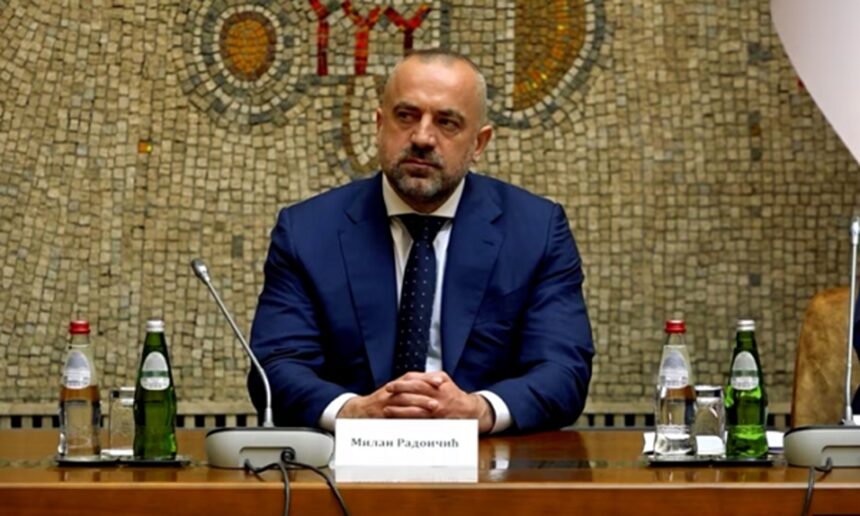
Milan Radoičić, who is under investigation over the armed attack in Banjska, appears to have disappeared, while Serbian authorities have yet to clarify his whereabouts despite a court-ordered arrest warrant.
According to N1, Radoičić is not in detention, even though the Higher Court in Belgrade has ordered his arrest. Neither the court nor the Serbian Interior Ministry has responded to questions about whether he reported to the police on November 15, as required, or whether he has left the country.
Radoičić is subject to a measure prohibiting him from leaving Serbia and is required to report to the police on the first and fifteenth of every month.
Following concerns that he may have failed to fulfil this obligation, the Higher Court ordered his detention and issued an arrest warrant.
“The Higher Court has ordered detention for the defendant M.R., with the measure taking effect from the moment of his arrest and lasting for a maximum of 30 days. The court has also ordered the issuance of an arrest warrant by the Belgrade Police Directorate’s Criminal Police Department,” the court said in a statement.
Prosecutor Radovan Lazić explained that the issuance of an arrest warrant means Radoičić is considered a fugitive if he has failed to comply with the court’s reporting requirements.
He added that the court has the legal authority to impose stricter measures, including detention or house arrest, if the existing restrictions have been violated.
Unconfirmed reports place Radoičić in Russia
Former Serbian Security Intelligence Agency (BIA) inspector Milan Zvezdanović has claimed that Radoičić may have left Serbia and is currently in Russia. However, he told N1 that his information was unofficial and has not been independently confirmed.
Serbian authorities have not publicly clarified whether Radoičić has left the country. The Interior Ministry also declined to answer N1’s questions about whether he reported to the police on November 15.
Radar journalist Vuk Cvijić said it would not surprise him if Radoičić had been allowed to leave Serbia and relocate to a country where extradition could be difficult.
He pointed to previous cases involving Serbian nationals who fled to Russia and were not extradited, including individuals who left the country after the political changes of October 5, 2000.
Questions over his connections to Serbia’s political leadership
Radoičić’s whereabouts have attracted renewed attention because of his longstanding connections to figures associated with Serbia’s outgoing political leadership.
Cvijić argued that the authorities’ silence raises questions about the relationship between individuals suspected of criminal activity and state institutions.
He also suggested that Radoičić could possess information about people within the political and security structures, potentially making him an important witness.
Radoičić was last publicly filmed approximately a month ago, attending a rally of the Serbian Progressive Party (SNS) in Kragujevac, where he was seen alongside Danilo Vučić, the son of Serbian President Aleksandar Vučić.
N1 also contacted Radoičić directly to establish whether he had left Serbia, but received no response.
His current location remains officially unconfirmed, while questions continue over whether Serbian authorities know where he is and whether they have taken effective steps to enforce the court’s arrest order.