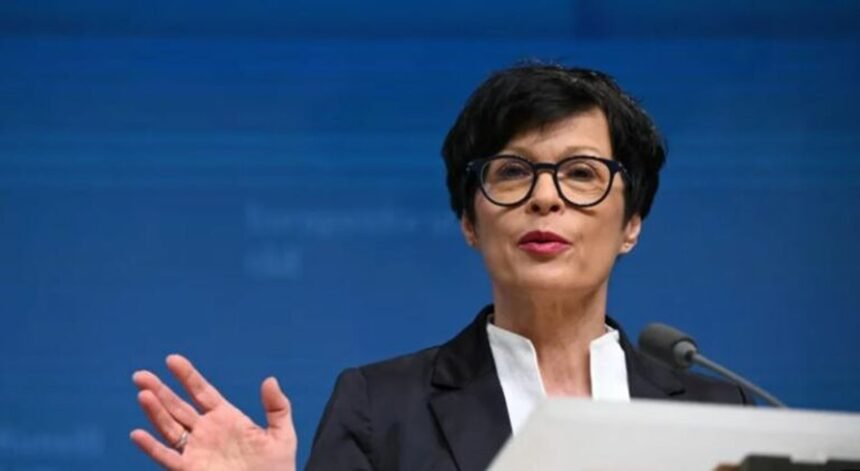
European Commissioner for Enlargement Marta Kos has described 2026 as a year of European Union enlargement, saying the autumn will be particularly important for the bloc’s enlargement agenda, while highlighting progress in several candidate countries without mentioning Kosovo.
In an interview with Deutsche Welle ahead of a meeting of foreign ministers within the framework of the Berlin Process, Kos discussed the European Commission’s latest proposal for gradual integration of candidate countries before full EU membership.
She said the merit-based accession process requires time, but argued that the current geopolitical situation means the EU cannot always afford to wait until the completion of the full accession process.
“If we want to achieve our goal, and our goal is a secure and stable Europe based on European values, then we will try, through the so-called pre-accession review, to identify together with the member states areas in which candidate countries that need more time can be offered more Europe even before full membership,” Kos said.
She stressed that gradual integration would not replace full EU membership, but would allow candidate countries that meet the necessary criteria in specific areas to benefit from partial integration before joining the bloc.
Kos pointed to the Central European Free Trade Agreement (CEFTA), which includes Western Balkan countries as well as Moldova and Ukraine, and said the EU would soon extend roaming benefits to the Western Balkans.
“These are areas that are normally available only to member states, but they show what we can do,” she said, adding that there are many other possibilities for similar forms of integration.
Montenegro Could Join EU in 2028
Asked about Montenegro’s progress, Kos said the country was already in the final stage of its path toward EU membership.
She said Montenegro could complete negotiations relatively quickly and noted that preparations for its accession treaty and financial package were already under way.
“If everything goes according to plan and the member states support the process, Montenegro could become an EU member in 2028,” Kos said.
Serbia Expected to Deliver on Democratic Standards
Regarding Serbia and its upcoming elections, Kos said the European Commission expects every candidate country to demonstrate commitment to European values, democratic development, the rule of law, the fight against corruption and an independent judiciary.
She described the elections as a potential catalyst for determining the direction Serbia wants to take in the future.
“Serbia’s place is in the European Union, and I am ready to do everything I can to help the country become an EU member,” Kos said, while adding that Serbia must also deliver results, which she said had not happened in recent years.
Bosnia and Herzegovina
Kos also expressed hope that Bosnia and Herzegovina could make progress in its accession process following its elections.
According to Kos, the country needs to adopt two laws and appoint a chief negotiator before the EU can begin the screening process covering the accession chapters.
She said she hoped the elections would bring new momentum and politicians who would act in the interests of the country as a whole, while protecting Bosnia and Herzegovina’s territorial integrity and sovereignty.
‘This Autumn Will Be the Autumn of Enlargement’
Kos said she remained optimistic about the EU’s enlargement agenda and described 2026 as a particularly significant year.
“Yes, I am optimistic about enlargement. This year really is the year of enlargement, and especially this autumn, which has just begun, will be the autumn of enlargement,” she said.
Kos said that during the first nine months of 2026, the EU had opened or provisionally closed more negotiating chapters than in any other year over the previous 25 years.
She highlighted Montenegro’s prospects for membership, describing it as the first country since Croatia joined the EU in 2013 to have what she called a realistic prospect of becoming a member.
Kos also praised Albania’s progress, while saying the EU hoped to open all negotiating clusters for Moldova and Ukraine by the end of the year.
“These are the countries that are leading the process,” she said, arguing that the EU had not witnessed such enlargement momentum since Croatia’s accession.