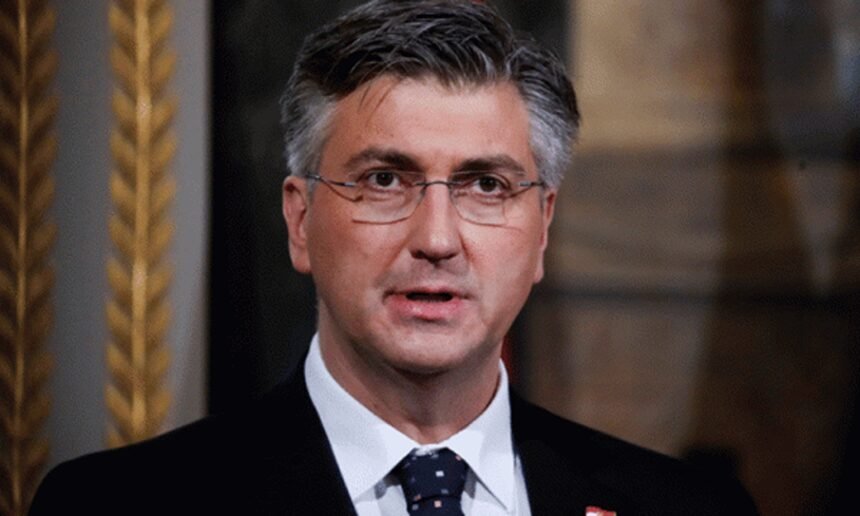
Ukraine must not put “a single drop of ink” on any document that would legally transfer its territory to Russia, Croatian Prime Minister Andrej Plenković stressed on Thursday in Davos.
Speaking at the World Economic Forum (WEF) in the Swiss alpine town, Plenković participated in a panel discussion on Ukraine alongside NATO Secretary General Mark Rutte, Finnish President Alexander Stubb, Dutch Prime Minister Dick Schoof, and Latvian President Edgars Rinkēvičs.
Plenković emphasized that Croatia belongs to the group of countries that are “clearly pro-Ukrainian when it comes to solidarity and support.”
“This comes from our own experience. Due to the aggression of Greater Serbia in the early 1990s, Croatia also had 27 percent of its territory occupied at one point,” he said, noting that Ukraine currently has 19.5 percent of its territory under occupation.
Plenković underlined that all peace agreements have two dimensions: the moment and context in which they are signed, and their long-term consequences.
In this sense, he stressed that Ukraine “must not put a single drop of ink on a document that would de jure surrender its territory.”
This is of fundamental importance not only for Ukraine, he said, but also to prevent a precedent that would threaten the stability of the international system, international law, and future relations.
Addressing Ukraine’s path toward European Union membership, the Croatian Prime Minister noted that there are now visible signals of a different EU approach to enlargement, in which the geopolitical dimension has become extremely important—representing an opportunity for Ukraine’s faster integration.
However, he added that achieving this would require an internal EU discussion on key issues related to its absorption capacity, including the impact of Ukraine’s accession on the EU budget, major policies such as agriculture and cohesion, as well as decision-making processes.
Ukraine should be aware that some countries, such as the Netherlands, have reservations regarding its accession for these reasons, Plenković said.
“One thing is political aspiration, and another is a genuine consensus on accession and its timing,” he stated, according to Hina.
During the panel, Finnish President Alexander Stubb criticized the argument that Russia does not want to end the war because it believes it can make further battlefield gains.
“Russia actually does not want the war to end because it is extremely costly for Putin—they will not be able to pay Russian soldiers once the war ends,” Stubb said.
He added that the Russian economy is “suffering,” citing non-existent economic growth, inflation that could rise to 30 percent by the end of the year, and an interest rate of 16 percent.
Russia is also losing a large number of soldiers, and according to Stubb, continued support for Kyiv and sustained economic pressure on Russia will ultimately lead to a Ukrainian victory.
Referring to Stubb’s remarks, Plenković noted that the “main problem” is that the weakening of the Russian economy has not resulted in political change inside Russia.
“In other circumstances, we would see civic movements, civil society, free media, independent institutions, and an opposition—and we do not see that there, nor any indication that this will change,” the Croatian Prime Minister concluded.